
Range anxiety has given way to a more practical question for many Australian buyers: how long does it take for an electric vehicle to charge? The honest answer is that it depends. Plugged into an ordinary power point, a car can take more than a day to fill 1. On a home wall charger it is usually an overnight job 1, and at a fast charger on the highway a big top-up can take well under an hour 2. This guide explains the three ways to charge, how long each takes, what slows charging down, and how drivers plan around it.
Which cars need charging
Not every car with a battery plugs in. A conventional hybrid charges its small battery as it drives and never needs a cable, so this guide is about two kinds of car:
- Battery electric vehicles, which run on electricity alone and must be charged from an outside source.
- Plug-in hybrids, which pair a petrol engine with a larger battery that can be charged from the grid. Plug-in hybrids have typically offered an electric range of about 24 to 97 km 3, so their charging times are shorter because their batteries are smaller.
Electric cars are no longer a niche purchase. The Electric Vehicle Council's State of EVs 2025 report found that electric vehicles made up 12.1% of all new car sales, up from 9.61% in 2024 4. If you are weighing one up, our article asking whether electric vehicles are better for the environment covers the bigger picture.
Charging from a household power point
The simplest way to charge is with the cable that plugs into a normal power point. The RACV calls this Level 1 or trickle charging, and notes that standard power points can only deliver a maximum of 2.4 kW of charging power 1. Its estimate for a full charge this way is 20 to 40 hours or more 1.
That sounds slow, and it is, but it can still work. Most drivers do not empty the battery every day. If you drive a modest distance and plug in each evening, a power point may put back what you used. It is less useful if you regularly drive long distances or arrive home with a near-empty battery.
Waiting for an electric vehicle to charge at home
A dedicated wall charger is the usual answer for owners with off-street parking. The RACV says dedicated wall chargers provide Level 2 charging 1. Its figures for a full charge are:
- a 7 kW single-phase unit: 8 to 12 hours, adding about 35 to 40 km of range per hour 1
- a 22 kW three-phase unit: 3 to 8 hours, adding about 50 to 130 km of range per hour 1
Evnex, which makes chargers, gives similar estimates for a car with a 64 kWh battery: about 9 hours on a 7.4 kW single-phase charger and about 3 hours on a 22 kW three-phase charger 2.

Why your car may not charge at the charger's full speed
The charger is only half of the equation. When an electric car charges from an AC supply, its own onboard charger converts the power to DC for the battery, and that onboard unit has a maximum rate. Evnex's example is a car whose onboard charger tops out at 6.6 kW: plugged into a 22 kW wall charger, the highest speed it could reach on AC would be 6.6 kW 2. Before you pay for a three-phase charger, check what your car can accept, and whether your home has three-phase power.
Plugs and running costs
The RACV says dedicated chargers usually come with a universal Type 2 connector, which it describes as compatible with all new electric cars sold in Australia 1. Untethered units, which use a separate cable, can also accept older Type 1 plugs 1.
Home charging is also where the running cost savings are biggest. The RACV's example is a Kia EV5 fully recharged overnight on a 7 kW home charger at an off-peak rate of 15c per kWh for about $13 1. Its tips are to schedule charging for off-peak periods and to use rooftop solar during daylight hours where you have it 1.
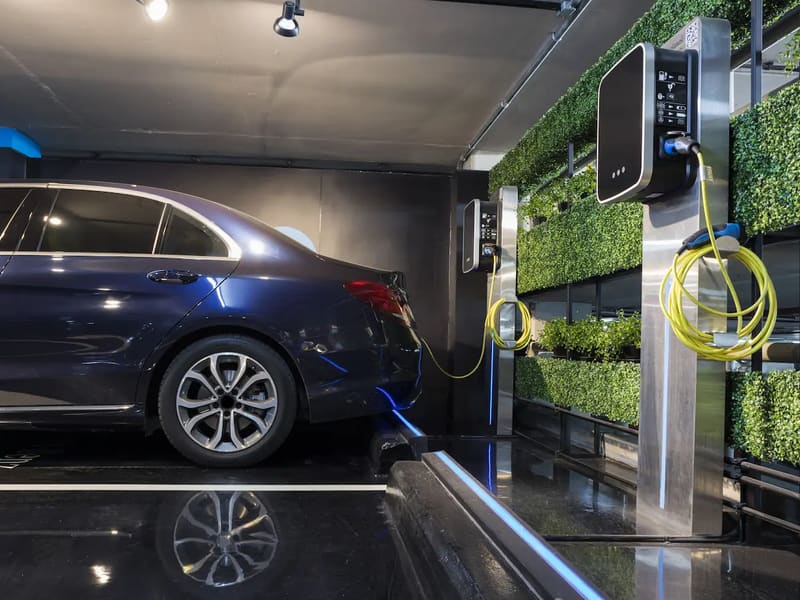
Fast charging on the road
For long trips, DC fast chargers do the heavy lifting. The difference is in where the power is converted. A DC charging station supplies DC power directly to the vehicle, bypassing the car's onboard converter 3, so it can charge far faster than any home unit. Evnex's estimates for a 64 kWh battery are 2:
- a 50 kW DC rapid charger: about 1 hour to reach 80%, adding around 300 km of range per hour 2
- a 175 kW DC ultra-rapid charger: about 15 minutes to reach 80% 2
Those are best-case numbers. Evnex notes that real speeds vary with battery size, and that only some cars accept the higher speeds an ultra-rapid charger can offer 2.

Why fast charging slows near full
If you watch a fast charge, you will see it slow down as the battery fills. Evnex says the charging rate usually decreases significantly towards the end of the charge, with diminishing returns as you approach 100%, so DC charging is usually stopped at about 80% 2. On a road trip, it is often quicker to make two short stops than one long one.
Connectors at public chargers
Fast chargers use their own DC plugs, so it pays to know which one your car has. Most of the world outside North America uses the Combo 2 style of vehicle inlet 3. An older standard, CHAdeMO, is still found on some cars and chargers. Wikipedia notes that CHAdeMO and CCS both charge to 80% in approximately 20 minutes in their original forms, but the two systems are incompatible 3. If you are looking at a used electric car, check its fast-charging plug against the chargers on the routes you drive.
How many fast chargers Australia has
The public network has grown quickly. The Electric Vehicle Council counted 1,272 fast-charging locations in its State of EVs 2025 report, 20% more than in June 2024, with at least 4,192 high-power public charging plugs 4. Before a long country trip, check where the chargers are along your route, using your car's navigation or a charging map app.
What else changes the charging time
Several things decide how long a particular charge takes:
- Battery size. Evnex puts it simply: the larger the battery and the slower the charger, the longer it takes to reach a full charge 2.
- How much you need. Topping up 40 km is a different story to charging to full from empty 2. Most daily charging is a top-up, not a full charge.
- The car's limits. Both the onboard charger for AC and the car's maximum DC rate cap the speed, whatever the charger can offer 2.
- Conditions on the day. Charging power can vary over a session because of limits set by the charge controller 3, so two charges on the same charger can take different times.
Keeping an eye on a charging session
You do not have to stand next to the car while it charges. The RACV notes that many electric cars have apps you can use to check how the charge is progressing, and that some dedicated wall chargers offer remote monitoring through a smartphone app as well 1. At public chargers, the same kind of app usually shows when the car has reached the level you set, so you can move it and free the bay for the next driver.
Charging questions to ask before you buy
Charging speed is part of the car you buy, not only the charger you use. Before you commit to a new or used electric car, ask:
- What is the car's maximum AC charging rate, set by its onboard charger? 2
- What is its maximum DC fast-charging rate, and which fast-charging plug does it use? 3
- Does it come with a portable charging cable for a household power point?
- If it is used, is there a recent report on the health of the battery?
- Where will you charge it each night, and does that location have single-phase or three-phase power? 1
The answers tell you how long a typical charge will take for your driving, which matters more than any headline figure.
Planning charging around your week
Most owners with a garage or a driveway charge at home overnight and use fast chargers only on long trips. That pattern keeps costs down and makes charging time almost invisible, because the car charges while you sleep.
If you rent, live in an apartment, or park on the street, charging takes more planning. Our article on why everyone in apartments cannot own electric cars looks at the hurdles, and our explainer on what happens to old electric vehicle batteries covers what comes at the end of a battery's life.
For a deeper look at home charging options, the RACV's guide to charging an electric car at home compares power points and wall chargers in detail 1, and Evnex's table of EV charging times sets out the fast-charging numbers 2.
When you are ready to shop, browse the cars on Car Domain, work out repayments with our car loan calculator, and read our safety guide for buyers before you inspect any car.
Sources
- RACV, How to charge an electric car at home: costs, charging times and tips, accessed 2 November 2026
- Evnex, How long to charge your EV, accessed 2 November 2026
- Wikipedia, Charging station, accessed 2 November 2026
- pv magazine Australia, Australia makes gains in EV uptake but faces steep road ahead, report finds, accessed 2 November 2026


