
For most electric car owners, the easiest place to charge is at home, overnight, while the car would be parked anyway. That works well for a house with a garage or a driveway. It is much harder in an apartment building, where the car park and the wiring are shared, and where one owner cannot simply call an electrician. The 2021 Census counted apartments as 16 per cent of Australia's private dwellings 1, so this is not a niche problem. This guide explains why EV charging in apartments has been difficult, what has changed in the rules, and how a buyer who lives in a unit can plan for an electric car.
Why EV charging in apartments is harder
In a house, the owner controls both the switchboard and the parking space. In a strata building, most of that is common property. Parking areas are typically decided on by the owners corporation or the strata body, and some installations may also need council approval 6. A renter has a further step, because they may need approval from their landlord or property manager as well 6.
Even an owner with a title to a car space usually needs to run a cable through shared areas back to a switchboard. That work touches property that belongs to every owner in the building, so the owners as a group have a say in it.
The building's power supply
The second hurdle is electrical capacity. An apartment building's supply was sized for the apartments and shared services such as lifts, not for dozens of cars charging at once. That is why building-wide solutions use load management. The Victorian Government's guide for owners corporations covers assessing electrical capacity and infrastructure constraints, along with load-management options 5. In New South Wales, the new right to charge rules expect the owners corporation to account for the building-wide load, and in most cases they rule out unmanaged chargers that connect to an individual owner's switchboard 4.
Fairness between owners
The third hurdle is fairness. When one owner installs a charger in the easiest spot, it can make a fair building-wide solution harder later. The Victorian guide makes exactly this point, noting that individual installations in easy-access spots can preclude equitable solutions for the whole building 5. Owners who do not drive an electric car also want to know they are not paying for someone else's electricity.
New apartment buildings must be EV ready
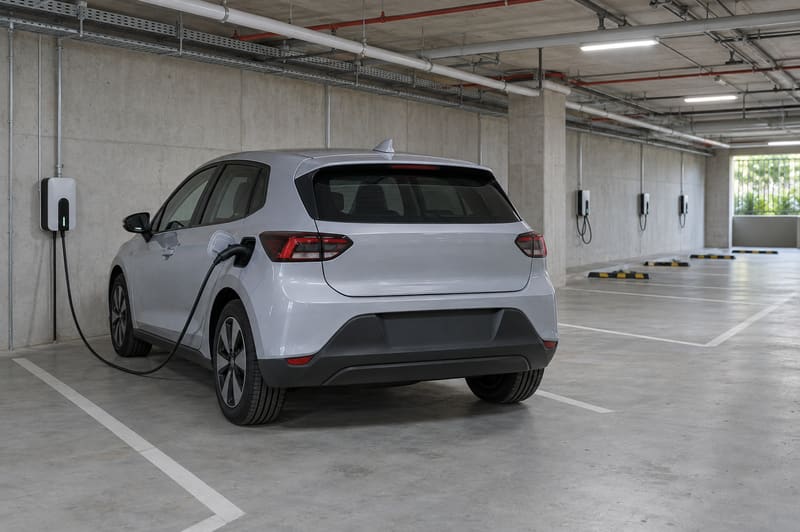
For new buildings, the National Construction Code now plans ahead. Clause J9D4 requires car parks associated with Class 2 buildings, which are apartment buildings, to be equipped with electrical distribution boards solely dedicated to EV charging 3. The circuits must be capable of supporting a charger that delivers at least 12 kWh between 11:00 pm and 7:00 am 3. Each board must be connected to a charging control system that can manage and schedule the charging 3.
The rule is about readiness, not finished chargers. There is no requirement to install chargers from the outset 3. The boards are designed to support future 7 kW Type 2 chargers 3, which means an owner in a newer building should find the heavy electrical work already done.
What the overnight minimum means
A minimum of 12 kWh over the eight hours from 11:00 pm 3 is modest, and that is by design. Most cars do not need a full battery every night. For a typical commute, a steady overnight top-up is usually enough, and a managed system can share the building's supply among many cars without overloading it. Check the energy use of the car you are considering, and compare it with your daily driving, to see whether that amount covers you.
The rules for existing buildings are changing
Older buildings are where most of the difficulty lies, and state governments have started to respond.
New South Wales: a right to charge
In October 2026, the NSW Parliament passed amendments to the Strata Schemes Management Act that give owners what has been called a right to charge 4. Owners can apply to install an EV charging station on their own lot, including installations that need changes to or work on common property 4. Strata committees cannot unreasonably object to the installation, and by-laws that unreasonably prohibit charging stations can be invalidated 4.
The right has limits. The owners corporation chooses the charging option that suits the building and must account for the building-wide load 4. The legislation also sets maximum times for replying to requests 4. In most cases the owner or tenant pays for the charger itself 4. Check the commencement date before relying on the new rules, because the reporting on the bill's passage did not give one.
Victoria: a guide for owners corporations
In August 2026 the Victorian Government released an EV-ready guide for owners corporations 5. It recommends that each owners corporation set up an EV strategy so it can make informed, fair and lawful decisions 5. The guide also covers how to divide costs fairly, from infrastructure to electricity, and which approvals proposed works need 5.
It deals with the practical side of running a shared system too. It covers electrical safety and insurance, and it also deals with supplier contracts and billing 5. It discusses surveys of owners about their charging needs, and it runs to 34 pages with case studies 5. A committee member who reads it before the first request arrives will be far better placed than one who reads it afterwards. It is a practical starting point for a committee that has received its first request.
Grants for apartment buildings in NSW
New South Wales also funded upgrades directly. Its EV ready buildings program offered $10 million to help eligible apartment buildings 2. It covered 80 per cent of eligible infrastructure costs, up to $80,000 per building 2. The grant is now closed, with stage 2 applications closing on 8 October 2025 2. The program page notes that 15 per cent of the NSW population live in apartments and there are nearly 84,000 strata schemes in the state 2. Watch for future rounds if your building missed out.

Charging options when you live in an apartment
Even without a charger in your own space, an electric car can still work. The Electric Vehicle Council lists several options 6:
- a charging station installed in a driveway or other suitable location;
- a car parked safely near a power point, with the outlet owner's permission;
- public charging, which it calls essential for owners who cannot charge where they live.
Shared chargers in the car park
Many buildings start with shared chargers in a visitor or common area, managed by a booking or billing system. It is often quicker to approve than individual chargers, because it involves one installation rather than many. The trade-off is convenience: you move the car to the charger and back, rather than plugging in where you park.
Public and workplace charging
Some apartment owners rely on public chargers near home or at the shops. It works best for drivers who do modest distances and can top up while doing something else. The costs and convenience vary a lot by suburb, so map the chargers near your home before you buy.
How to plan before you buy an electric car
If you live in an apartment and are thinking about an electric car, a little homework first can save frustration later:
- Ask your strata manager or owners corporation whether the building has an EV strategy or an approved charging plan 5.
- Find out whether the building was built to the newer code, with dedicated EV distribution boards in the car park 3.
- If you rent, ask your landlord or property manager early, because their approval may be needed 6.
- In NSW, read up on the new right to charge before you make a request 4.
- Work out your daily distance, and whether public chargers near home or work could cover it 6.
Buying an apartment with EV charging in mind
If you are buying an apartment, add charging to your checklist. Ask whether any chargers are installed or planned, and read the minutes of recent owners corporation meetings for charging requests. A building that has already done its planning can save you a long approval process later.
The bottom line on EV charging in apartments
Living in an apartment no longer rules out an electric car, but it does take more planning than a house. New buildings are being made ready by the building code 3, and existing buildings now have clearer rules and guides 4. For now, the owners who do best are the ones who start talking to their building early.
The Electric Vehicle Council's guide to charging without a garage is a useful next read, and building managers can read the ABCB's explanation of the EV charging clause.
For the wider picture, our history of Tesla in Australia shows how electric cars reached local roads, and our guide on why you should never skip a scheduled service applies to electric cars too. When you are ready to shop, browse the cars for sale on Car Domain, plan the finance with the car loan calculator and read our safety guide for buyers before you meet a seller.
Sources
- Australian Bureau of Statistics, 2021 Census count includes Australians living on wheels and water, but most of us still firmly on land, accessed 2 November 2026
- NSW Government, NSW Climate and Energy Action, Electric vehicle ready buildings, accessed 2 November 2026
- Australian Building Codes Board, J9D4 Facilities for electric vehicle charging equipment, accessed 2 November 2026
- The Driven, Right to charge strata legislation paves way for EV chargers to be installed in apartment buildings, accessed 2 November 2026
- The Driven, State government releases detailed guide on how to get EV charging in strata buildings, accessed 2 November 2026
- Electric Vehicle Council, Are there options for charging an electric vehicle in apartments or homes without a garage?, accessed 2 November 2026


