
More electric cars on Australian roads means more big batteries that will one day wear out. So what happens to old electric vehicle batteries when they are no longer good enough to drive a car? The short answer is that very few should ever be thrown away. A tired pack can be reused to store energy, and at the end of that second life its metals can be recovered and made into new batteries. This guide explains how long the batteries last and how reuse and recycling work. It also covers what Australia is doing to prepare for the large number of packs that will reach the end of their lives in the coming decades.
How long electric car batteries last
An electric car's battery does not fail all at once. It loses capacity gradually, a normal process that occurs as the pack goes through charge and discharge cycles 1. The car still works; it just goes a little less far on a full charge.
The numbers are reassuring. The RACV says new electric cars sold in Australia include a battery-specific warranty, often for eight years or 160,000 km, whichever comes first 1. Some makers also guarantee that the battery will keep about 70% of its capacity over that period 1. The Electric Vehicle Council expects electric cars to have an average lifespan of about 15 years, or roughly 180,000 to 200,000 km 1.
What real-world checks are finding
Early fears about battery wear have not been borne out so far. The NRMA had completed 50 battery health checks for its members by July 2026 2. Most cars fell in the normal range for their age: 15 cars built between 2017 and 2023 were below average, and five were above average 2. The oldest car tested was a 2016 model with 218,000 km on the odometer 2.
The NRMA's testing partner, Aviloo, says its data increasingly shows that real-world battery degradation is generally performing better than many early industry predictions 2. The NRMA is careful to call its 50 checks a useful starting point, not a full picture, and notes that Australian conditions such as hot climates and frequent DC fast charging can affect how a battery ages 2.

Looking after a battery
The RACV's advice for slowing battery wear is simple 1:
- park in shade or a garage on hot days, because excessive temperatures can speed up degradation 1
- favour slower AC charging for everyday use 1
- keep the battery between 20% and 80% charge for daily driving 1
When a battery does reach the end of its useful life in a car, it can be repaired or replaced once it is out of warranty 1. The battery is the car's most expensive component, and the RACV puts replacement costs anywhere from a few thousand dollars to well over $10,000, so a manufacturer's quote is the best starting point 1. For most owners, though, the battery is likely to outlast their time with the car.
A second life as energy storage
A battery that is no longer right for a car still has plenty of use left. The RACV notes that a battery at the end of its useful life in a car can be repurposed for stationary storage 1. A stationary battery does not need to be light or compact, and it rarely needs the full capacity a driver depends on for range.
One of the best known examples is in Amsterdam. In June 2018, the Johan Cruijff ArenA, the city's football stadium, switched on a storage system with a total capacity of 3 megawatts, made from the equivalent of 148 Nissan LEAF batteries, both second-life and new 3. The stadium uses it to provide back-up power, reducing the use of diesel generators, and to ease strain on the grid during concerts 3.
The same idea can work at a smaller scale, storing solar power generated during the day for use at night. Each year a pack spends in storage delays the point at which it has to be recycled.

How electric car batteries are recycled
Eventually every battery reaches the point where it is not worth reusing, and then it should be recycled. Lithium-ion batteries contain valuable metals. Recycling processes must recover metals such as cobalt and nickel from spent cells, and a significant share of lithium as well 4.
There are two main industrial methods 4:
- Pyrometallurgy uses high heat. It is one of the most widely used methods for lithium-ion batteries, but it is energy intensive and has high capital costs.
- Hydrometallurgy first extracts the metals in a liquid solution, typically using acids. It uses less energy, but the chemicals raise safety concerns.
A third approach, direct recycling, aims to regenerate the cathode material without breaking down its structure, but it is not yet commercialised 4.
How much can be recovered
Results vary widely. Current recycling processes recover approximately 25% to 96% of the materials in a lithium-ion battery cell 4. The recycling company Redwood Materials has reported recovering more than 95% of important metals, including lithium and cobalt 4.
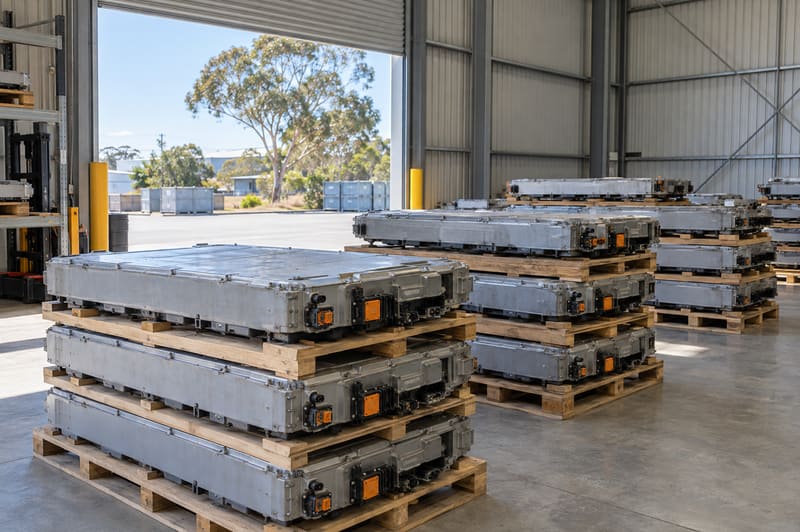
The economics are not settled yet. One estimate puts the cost of extracting lithium from old batteries at five times that of mined lithium 4. Recycling also involves electrical and chemical hazards, as well as the risk of fire, which is one reason a car battery must never be put out with household rubbish 4.
Why recycling old electric vehicle batteries matters
Australia has not had a strong record with lithium-ion batteries in general. In 2018, CSIRO reported that only 2% of the country's annual 3,300 tonnes of lithium-ion battery waste was recycled 6. The majority was shipped overseas and the remainder went to landfill 6. CSIRO said the waste was growing by 20% a year and could exceed 100,000 tonnes by 2036 6.
That figure covered all lithium-ion batteries, from phones to power tools, and it is now several years old. But it shows the size of the gap. CSIRO contrasted it with lead-acid batteries: of the 150,000 tonnes sold in 2010, 98% were recycled 6. And the prize for doing better is large. If recycled, CSIRO said, 95% of the components of a lithium-ion battery can be turned into new batteries or used in other industries 6.
Electric car batteries are a different case from small batteries, because each pack is large and valuable, and it can be traced to a particular car. That should make them easier to collect than a phone battery in a kitchen drawer, provided the systems to collect them are in place before the volumes arrive.
What Australia is doing about spent batteries
The volumes coming are large. In 2023, the Battery Stewardship Council released preliminary findings that spent electric vehicle batteries would reach roughly 30,000 tonnes a year by 2030, and that Australia would need to recycle 1.6 million tonnes by 2050 5. The Federal Government commissioned the council to lead industry consultation on stewardship for these batteries, working with the Federal Chamber of Automotive Industries and the Motor Trades Association of Australia 5.
Its chief executive warned at the time that electric car batteries present increasing risks and opportunities which the vehicle industry is yet to deal with at scale 5. Early action, the council argued, can help prevent hoarding and fires 5.
New rules for smaller batteries
Regulation is starting with smaller batteries. In New South Wales, the Product Lifecycle Responsibility Regulation 2026 came into effect on 1 October 2026, establishing what the law firm Hamilton Locke describes as Australia's first mandatory product stewardship scheme for batteries 7. It covers household batteries and removable rechargeable batteries of 5 kg or less 7. Power banks are included too, along with the batteries in e-bikes and e-scooters 7. Brand owners must join a stewardship organisation and report each year 7. Car traction batteries are not among the categories the firm lists.
What this means if you buy an electric car
For a buyer, the main lessons are practical:
- Check how much of the battery warranty is left, in years and kilometres, and what capacity it guarantees 1.
- On a used electric car, ask for a battery health report. The NRMA suggests using it alongside other checks such as service records and tyre wear, and notes that a low result does not automatically lead to a warranty claim, because terms differ by maker 2.
- Look after the battery with sensible charging and parking habits 1.
- If a battery ever needs replacing, ask the repairer or the manufacturer what will happen to the old pack. A battery that leaves your car should go to reuse or a recycler, never to a tip or a backyard shed.
A used electric car with a healthy battery and a clear service history can be a sound buy. The battery report, the warranty and the history together tell you far more than the odometer alone, so ask for all three before you agree on a price.
You can read the RACV's guide to battery life for more on warranties, and the NRMA's battery health findings for the latest test results.
On our blog, find out how long it takes an electric vehicle to charge and whether electric vehicles are better for the environment. When you are ready to shop, browse the cars on Car Domain, and read our buyer safety guide before you inspect a car or hand over a deposit.
Sources
- RACV, How long do electric car batteries and motors last?, accessed 2 November 2026
- The NRMA, 50 EV battery health checks in: what The NRMA is learning, accessed 2 November 2026
- Johan Cruijff ArenA, The 3 megawatt energy storage system in Johan Cruijff ArenA is now live, accessed 2 November 2026
- Wikipedia, Battery recycling, accessed 2 November 2026
- Australian Manufacturing, EV batteries pose big risks, to reach end of life in Australia by 2050: Battery Stewardship Council, accessed 2 November 2026
- CSIRO, Australia to lead lithium-ion battery recycling charge, accessed 2 November 2026
- Hamilton Locke, New Energy Bulletin: Australia's first mandatory battery stewardship scheme, what you need to know, accessed 2 November 2026


