
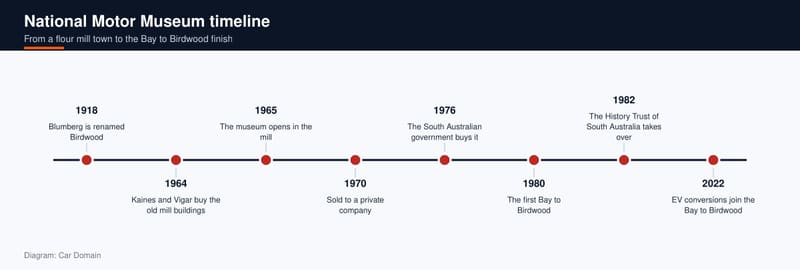
In 1964, two men bought an old flour mill in the Adelaide Hills. Not a garage. Not a showroom. A flour mill. The next year they opened it as a museum, and that odd purchase grew into the National Motor Museum, Australia's largest motor museum. It sits in the small town of Birdwood, around 44 km from Adelaide city centre, and every year it is the finish line for a parade of old cars that tens of thousands of people turn out to watch.
The story is part local history, part shed full of oddities and part road trip. There is even a bus that needs saving. Let's start with the town.
A German mill town with a soldier's name
Birdwood was not always Birdwood. Prussian settlers from the area around Zullichau named it Blumberg. The name probably came from Groß Blumberg, a village on the Oder River in the settlers' home district.
Migrants who had settled temporarily at Lobethal began looking for land of their own in 1848, and Pastor Fritzsche recommended a spot beside the Torrens. By the 1850s the town was prospering, and the district was producing enough grain to justify a proper mill. That building, the Blumberg Flour Mill, is now the site of the motor museum.
During World War I, Blumberg's German name was anglicised along with many others in the region in 1918. The new name honoured Sir William Birdwood, the Australian Imperial Force general who led the ANZACs at Gallipoli. Around the same time, the government closed the German-language school.
You can read more in the Birdwood township history, but one detail jumps out at us. Birdwood once had a station on the Mount Pleasant railway line. That line closed in 1963. The very next year, two men bought the old mill and started turning it into a museum. The trains left and the cars moved in. You could not script it better.
How the National Motor Museum began in the Old Mill
The two men were Jack Kaines and Len Vigar. They bought the old mill buildings in 1964 and opened the museum in 1965. The name on day one was a proper mouthful: the Birdwood Mill Pioneer, Art and Motor Museum. That is three ideas squeezed into one title.
It did not stay in their hands for long. In 1970 the museum was sold to a private company. In 1976 the government of South Australia bought it, and from 1982 it came under the History Trust of South Australia, which still runs it as a social history museum focused on Australian motoring history. For years people called it the Old Mill, or Birdwood Mill.
Today the collection lives in a modern complex right next to its original home, the Old Mill on Shannon Street. It holds a large and historically important collection of cars, motorcycles and commercial vehicles, with over 350 vehicles on display as of 2009.
We reckon that mix is the secret. A museum that only showed supercars would be a one trick pony. This one does trucks, vans, bikes, prototypes and the odd ute, and the everyday machines often tell the best stories in the room. The museum's Wikipedia entry lists dozens of the vehicles on show, and it reads like an Australian family album with a few exotic cousins thrown in.
Steam, brass and a coachbuilt Rolls-Royce
The oldest names on that list reach right back to the start of motoring. There is an 1897 Peugeot Type 17 chassis, an 1899 Shearer Steam Carriage and a 1900 De Dion-Bouton Type E Vis-à-vis.
The Shearer matters more than its age suggests. When the Bay to Birdwood began, the perpetual trophy for its Concours d'Elegance was designed around the Shearer Steam Car. That trophy is held at the museum, with the winners' names engraved on it. So a steam carriage from 1899 ends up crowning cars built decades later. We love that.
Then there is the 1904 Ohlmeyer 'Jigger' Tourer, which has one of the best names in the building. The list also has a 1907 Rover 6hp, a 1909 Merryweather Fire Engine and a 1914 Dixi R12 Tourer. A 1920 Palm Tourer and a 1924 Summit Tourer will send plenty of visitors reaching for their phones.
For those of us who lean towards the prestige end, the pick of the early cars is a 1925 Rolls-Royce 20 hp coupe wearing a Carrosserie Vanvooren body. Proof, if you needed it, that this museum's taste runs well beyond farm trucks. And if early Peugeots have you curious, our feature on the 1953 Redex Trial is a good next read.
Holden heroes and home grown oddballs
Holden casts a long shadow here. The History Trust's Holden & Me website explores Holden's enduring impact on South Australia and asks people to add their own Holden memories. The museum's Holden Heroes exhibition, a retrospective of the years 1948 to 2017, is listed as running until 31 December 2026.
The Holdens on the list cover a lot of ground: a 1958 Holden FC Special Station Sedan, a 1969 Holden Panel Van called 'Midnight Express', a 1976 Holden Sandman, a 1977 Holden Torana A9X hatchback and a 1980 HDT Commodore Brock Group A. There is also a 1974 Holden Torana supercharged drag car, which we suspect is about as subtle as a brass band.
Some of the most interesting Holdens wear other badges. The list includes a 2000 Chevrolet Lumina sedan based on the Holden Commodore and a 2004 Pontiac GTO based on the Holden Monaro. From Mitsubishi there is a 1983 Mitsubishi Magna sedan prototype and a 1996 Mitsubishi Verada wagon test mule, which is a lovely phrase in its own right.
Then come the true oddballs. A 1948 Hartnett prototype. A 1963 Zeta Runabout, a 1963 Lightburn Zeta Sports and a 1965 Zeta Sports. Few people will drive up the hill to see a Zeta. We reckon they should. If this section has you browsing classic cars for sale, we understand completely.
Adventurers, a phone car and a bus called Priscilla
The vehicle with the best travel story might be a 1956 Land Rover Series 1 LWB Station Wagon. It is one of two driven by the Leyland brothers in the film Wheels Across a Wilderness. The off-road theme carries on with a 1952 Vanguard Overland custom rebodied off-roader and a 1958 Land Rover Series 1 short wheelbase off-roader.
Then there is the 1980 Telecom Australia Phone Car. The list does not say how many calls were made from it. We would love to know.
The museum tells people's stories as well as machines'. One exhibition covers Alice Anderson's Motor Service. The History Trust describes Alice Anderson as Australia's first female garage proprietor. In 1919 she bought a block of land on Cotham Road in Kew, Victoria, and opened a garage with the ambition of making garage work a suitable career for women.
And then there is the bus. The museum is asking for help to restore the Priscilla bus, under the banner Destination Fabulous and the line "Help us save the Queen". We cannot think of a better fundraising slogan in Australian motoring.
The Bay to Birdwood ends at the mill
Most museums have a car park. This one has a finish line.
The Bay to Birdwood began in 1980. Bob Chantrell of the Federation of Vintage Car Clubs (SA) raised the idea, inspired by the London to Brighton Veteran Car Run. The club approached Donald Chisholm, then the museum's general manager, and he agreed to be co-organiser. He also suggested, and agreed to provide, a perpetual trophy for the Concours d'Elegance based on the Shearer Steam Car.
The first event started at Colley Reserve in Glenelg. The name comes from Holdfast Bay, on which Glenelg sits. In 2001 the start moved to Barratt Reserve at West Beach, because housing developments were affecting the old starting point.
For years it was really two events. The Bay to Birdwood Run was for pre-1956 vehicles and the Bay to Birdwood Classic was for post-1956 vehicles, and they alternated between even and odd numbered years. Since 2020 it has been a single annual event that welcomes all historic vehicles 30 years and older. These days it is the RAA Bay to Birdwood, organised by the History Trust of South Australia through the museum.
A 70 km parade from the beach to the hills
The route runs approximately 70 km from the Adelaide foreshore up to the museum. Thousands of spectators line the roadside, and SA Police estimates are of 90,000 plus. The field takes in cars, motorbikes, buses, military vehicles and occasionally fire engines. Many drivers dress to match the period of their vehicle, which is exactly the sort of commitment we admire. At the end, hundreds of entrant vehicles are displayed on the museum's grounds.
The 2020 event was the 40th anniversary, and it was held during the COVID-19 pandemic. It was one of the first major large-scale public events held after the first national restrictions, and it drew around 90,000 spectators. The 2021 event did not go ahead. In 2022 the date moved from the last weekend of September to October, and the field was capped at 1500 vehicles.
You can dig into every twist in the Bay to Birdwood's history. Wikipedia now calls it one of the largest historical motoring celebrations of its type globally. Not bad for an idea borrowed from a run to Brighton.
Polish, patina and plugs
The trophies tell you what the event values. The Concours d'Elegance rewards polish. Recent pre-1950 winners include a 1932 Packard 905 Twin Six and a 1936 SS Jaguar Airline, and earlier Classic winners include a 1954 Aston Martin DB2/4 Coupe in 1999 and, delightfully, a 1957 BMW Isetta 300 in 2019.
Here is our slightly unpopular view. The best trophy on the day is not the concours. It is the Preservation award. It arrived in 2016 for vehicles that are substantially unaltered from original delivery and have never been restored or modified. Recent winners include a 1970 Mazda Cosmo Sport, a 1992 Volvo 940GL and a 1985 Holden VK HDT Calais Director. A perfect restoration tells you how much somebody spent. An untouched car tells you how it actually lived, and that is the better story every time.
Then there is the plug. In 2022 the event welcomed electric converted historic vehicles, which Wikipedia describes as a world first. The EV Conversion award goes to the most sympathetic conversion, the one that keeps as much of the vehicle's originality as possible. The first winner was a 1985 Holden MB Barina, and BMW 2002s took the award in 2024 and 2025. If you wonder where tired batteries end up, we have looked at what happens to old electric car batteries.
Making the trip up the hill
The museum is open daily from 10am to 5pm. It closes on Christmas Day and on days of catastrophic fire danger, which is a very Australian line to find on an opening hours page. It is approximately an hour's drive from Adelaide's CBD, and the area is not serviced by Adelaide Metro public transport, so plan on bringing a car.
For the serious end of the hobby, the National Motor Museum's own site lists the George Brooks Library and Learning Centre and a Vehicle Registration Database Search.
On the first Sunday of November every year, the museum and the Hot Bricks Club of SA co-host an event called MINIs at the Mill. It fits. The collection includes a 1977 Leyland Mini Moke and a 1978 Leyland Mini 1275 LS.
The mill went up because the district grew enough grain to justify it. These days it is where a 70 km river of old cars comes to a stop, beside a steam car trophy and a building that started out making flour.
Sources
- Wikipedia, National Motor Museum, Birdwood, accessed 12 November 2026
- Wikipedia, Birdwood, South Australia, accessed 12 November 2026
- Wikipedia, Bay to Birdwood, accessed 12 November 2026
- History Trust of South Australia, National Motor Museum, accessed 12 November 2026


