
One customer. Two seats. Four years of hand building. On Saturday 27 May 2017, the Rolls-Royce Sweptail was presented to the media at the Concorso d'Eleganza Villa d'Este in Italy. It was a car that will never be made again, built for the one man who had asked for it.
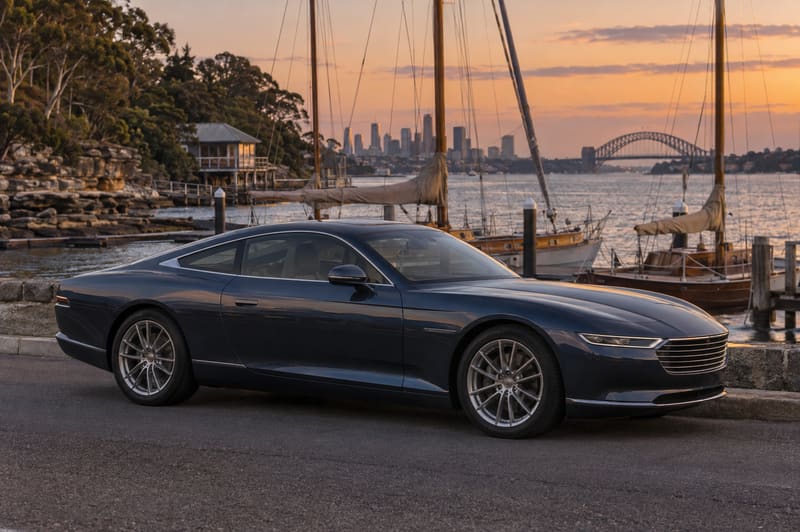
From the front it is a big, formal Rolls-Royce. From the back, the tail tapers away like the stern of a racing yacht. The roof is one sweep of glass, there is no back seat, and a bottle of champagne waits in the centre console for the press of a button.
We reckon it is one of the most charming cars of the past decade, and not because of the price. One customer talked a modern car maker into building a car the way coachbuilders did in the 1920s and 1930s, and that one-off sparked what Rolls-Royce calls the renaissance of contemporary coachbuilding.
A request that landed in 2013
In 2013, one of Rolls-Royce's most valued customers came to the company with a very particular request. That is how Rolls-Royce's announcement of the Sweptail puts it, and it never names him. It describes him as a connoisseur and collector of distinctive one-off items, super-yachts and private aircraft among them. The Wikipedia entry on the Sweptail says the car belongs to a Hong Kong based customer.
That is a long way past choosing a paint colour. He wanted a two-seat coupe, inspired by the coachbuilt Rolls-Royces of the 1920s and 1930s. He wanted a large panoramic glass roof. And he wanted a swept tail, a feature of certain 1920s Rolls-Royces that he admired so much he asked the company to reimagine it on his car.
About a year before the reveal, Rolls-Royce had shown 103EX, a Vision Vehicle that envisaged every Rolls-Royce being designed in its owner's image. According to the announcement, the mere idea of a modern coachbuilt Rolls-Royce was not enough for this connoisseur. He wanted his now.
The client struck up a close rapport with the design team led by Giles Taylor, then Rolls-Royce's director of design. Taylor called the result "the automotive equivalent of Haute Couture": the customer arrived with an idea, the designers advised him on his cloth, then cut it to fit him.
Four old Rolls-Royces on the mood board
The designers did not start from a blank page. Rolls-Royce named four old cars its team considered, and each gave something different.
From the 1925 Phantom I Round Door built by Jonckheere came grandeur, scale, flamboyance and drama. From Park Ward's 1934 Phantom II Streamline Saloon came the svelte, tapering glasshouse, a dramatic dash to axle proportion and the upswept angle of the rear. The 1934 Gurney Nutting Phantom II Two Door Light Saloon offered its elegantly falling waist rail and swept tail coachwork. And the 1934 Park Ward 20/25 Limousine Coupé added a flowing roofline, a rising rear and, once again, a swept tail.
That is a lot of 1934 for one car, and we love it. The other half of the brief came from the water, because the client was also inspired by many classic and modern yachts.
Taylor and his designers worked with the client over a number of years. "Our job was to guide, edit and finely hone the lines," Taylor said. Underneath, the car is no clean-sheet special: Wikipedia's entry says it is based on the Rolls-Royce Phantom Coupé, built from 2008 to 2016, and was hand-built over four years.
Why the Rolls-Royce Sweptail looks like a yacht from behind
From the front, it is all formality. The Pantheon grille is the largest of any modern era Rolls-Royce, milled from solid aluminium and then polished by hand to a mirror finish. Brushed aluminium frames the whole front face of the car.
From the side, the mood changes. The roofline runs back from the windscreen and overshoots the edge of the boot lid to emphasise the car's length, helped by long side windows and a wide C-pillar finisher.
Then there is the back, which is where the fun starts. Rolls-Royce calls the raked stern the ultimate homage to the racing yachts that inspired the client. Seen directly from behind, the taper contrasts hard with the upright front. The roof narrows towards the centre line and finishes in a "bullet tip" that houses the centre brake light.
Underneath, the bodywork wraps under the car with no visible boundary between the surfaces, a treatment Rolls-Royce likens to the hull of a yacht. The underside sweeps progressively upward at the rear, and that upward sweep is the swept tail that gives the car its name.
One more detail at the back might be our favourite. The registration number is 08, two digits milled from ingots of aluminium and polished by hand. Most of us just get a number plate from the rego office.
A glass roof, by special request
Rolls-Royce calls the roof the highlight, and it is the feature the client specifically asked for. It is an uninterrupted sheet of glass, which Rolls-Royce describes as one of the largest and most complex ever seen on a motor car of any marque. Polished aluminium rails frame it and channel it into a vanishing point at the rearmost edge of the cabin.
All that glass floods the cabin with natural light. There are only two seats in a car of this size, laid out as a classic GT, which Rolls-Royce says exudes "the romance of travel for its own sake". For once, the marketing line feels about right.
The materials are dark and light. Polished Macassar Ebony and open-pore Paldao wood run around the cabin, set against light Moccasin and Dark Spice leathers on the seats, armrests and dashboard top.
Where the rear seats would normally go, there is a vast expanse of wood: a mid-shelf with an illuminated glass lip, and a polished hat shelf inset with luggage rails, reached through an opening rear window.
Behind the occupants, a feature called the Passarelle joins the hat shelf in a teardrop. It carries the only visible sign of the car's name, with "Sweptail" debossed exactly on the centre line. Just the name, once, and no shouting about it.
Attaché cases, a wooden clock and a very cold bottle
The dashboard is the cleanest Rolls-Royce had made to that date, with only one control on it and the rest of the switchgear quietly moved elsewhere. Even the clock blends in. In what Rolls-Royce called a world first, its face is made from the thinnest Macassar veneer, so the backlight shines through the wood to show the hour marks. The only physical parts on the clock are its titanium hands.
Then come the party tricks. Hidden behind the coach doors on either side are two panniers, each deploying a bespoke carbon fibre attaché case, wrapped in matching leather and sized exactly for the owner's laptop. A matching luggage set lives in the boot, which is clad in the same wood as the hat shelf.
And the headline act. The whole centre console houses a one-off, hand-built mechanism that, at the touch of a button, presents a bottle of the client's favourite vintage champagne, from the year of his birth, along with two crystal flutes. As the lid of the chiller opens, the mechanism tilts the bottle into the perfect position to pick up.
Here is our slightly unpopular opinion. The champagne trick sounds like the star, but we think it is the least interesting thing in the car. The veneer clock is the cleverer idea: wood cut thin enough for light to pass through, with nothing on the face but titanium hands. That is the kind of detail that only happens when a client gives a design team years rather than months.
What coachbuilding meant before Goodwood
To see why Sweptail mattered, it helps to know what coachbuilding was. Rolls-Royce defines it as the art and science of creating bespoke bodywork on a pre-assembled chassis, a craft older than the motor car itself.
When Rolls-Royce was founded, car makers generally built a "rolling chassis" and sent it to a specialist coachbuilder for a body made to the client's specification. Some coachbuilders had simply switched over from horse-drawn vehicles. Until the 1930s, most built a wooden frame, usually in ash, and nailed, tacked or screwed aluminium or steel panels onto it.
According to Rolls-Royce, virtually all of its cars were coachbuilt until the 1950s. The tradition faded once semi-monocoque construction arrived with the Silver Shadow in October 1965, though the Phantom VI kept its separate chassis, in small numbers, until 1993.
There were always rules, even for the richest clients. Henry Royce insisted on fixed dimensions for the bulkhead behind the radiator, so every body kept the proportions of a true Rolls-Royce. Today the company still holds every car to the 2:1 ratio of body height to wheel diameter first set by the Silver Ghost in 1907.
There is a neat twist in the family tree, too. Rolls-Royce Motor Cars, the BMW subsidiary that built Sweptail, has made Rolls-Royce cars since 2003. Wikipedia's history of Rolls-Royce Motor Cars notes it has no direct relationship to Rolls-Royce-branded vehicles produced before 2003, other than having briefly supplied components and engines. In other words, Sweptail tips its hat to cars its maker did not build.
Goodwood's coachbuilding revival
Rolls-Royce Motor Cars has its headquarters and production at a 42-acre (17 ha) plant close to the Goodwood Estate in West Sussex. Rolls-Royce's coachbuild press kit calls Sweptail the first fully coachbuilt Rolls-Royce of the modern Goodwood era.
Today, Rolls-Royce Coachbuild lets a small, select group of clients specify the car's actual physical form, with body panels hand-sculpted by specialist craftspeople at Goodwood. Every project is a true one-off that will never be repeated.
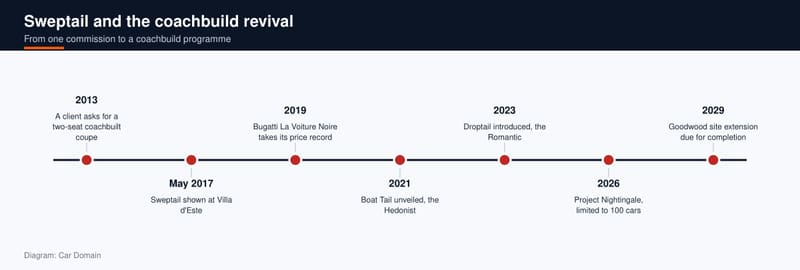
The press kit gives each modern coachbuilt car a personality. Sweptail is the Extrovert. Boat Tail, unveiled in 2021, is the Hedonist, an open-top built around its clients' love of hosting. Droptail, introduced in 2023, is the Romantic. Wikipedia describes Boat Tail as based on its predecessor, the Sweptail. Three Boat Tails were completed, the first two shown at Villa d'Este in 2021 and 2022, and at its owner's request the third has never been exhibited in public. Wikipedia lists Droptail as limited to four cars.
The scale is growing. Wikipedia lists Project Nightingale, from 2026, as the first series of models in Rolls-Royce's Coachbuild Collection, limited to 100 cars. Rolls-Royce says a site extension at Goodwood, due for completion in 2029, will give its Bespoke and Coachbuild teams room for more complex commissions. Not bad for an idea one customer brought to the company in 2013.
A price tag that did not last
Rolls-Royce's own announcement never mentioned a price. Wikipedia's entry says that at its debut in May 2017, the Sweptail was the most expensive new car in the world, costing around £10 million. That record lasted until 2019, when the Bugatti La Voiture Noire overtook it. If you want more Bugatti, our look at Bugatti's V16 engine in the Tourbillon is a good place to start.
We think the price was never the point, though. In 2023, Rolls-Royce Motor Cars had its highest ever annual sales, 6,032 cars. Sweptail is a production run of one, and it reads more like a commissioned portrait than a car. It has the registration 08, a clock face made of wood and a champagne vintage from the owner's birth year.
Most of us will never commission a car. If you are shopping on a more ordinary budget, there are Rolls-Royce cars for sale and plenty of coupes for sale on Car Domain, none of them with a champagne launcher as far as we know. And if rare metal is your thing, the story of Australia's only McLaren F1 is worth a read too.
Sources
- Wikipedia, Rolls-Royce Sweptail, accessed 10 November 2026
- Wikipedia, Rolls-Royce Motor Cars, accessed 10 November 2026
- Rolls-Royce Motor Cars, Rolls-Royce Sweptail: the realisation of one customer's coachbuilt dream, accessed 10 November 2026
- Rolls-Royce Motor Cars, Rolls-Royce Coachbuild: a glorious legacy, a spectacular future, accessed 10 November 2026


