
You would expect a crashed record car to end up in a museum or a scrapyard. The Babs land speed car ended up in a hole in the sand. After its fatal crash at Pendine Sands in Wales in March 1927, it was buried in the dunes and left there for decades. Then an engineering lecturer from Bangor went looking for it, armed with old photographs and a great deal of patience.
It is a story with a count, a 27-litre aero engine, a beach that doubled as a racetrack, a two-year hunt for a nephew in Walsall and a Land Rover doing one of the odder jobs of its working life. We reckon it is the greatest barn find in motoring, even though there was never a barn.
The count's fourth Chitty
Babs did not start life as Babs. It began as Chitty 4, one of a series of aero-engined cars built by Count Louis Zborowski, who called them Chitty Bang Bang. Because it was put together at Zborowski's estate, Higham Park near Canterbury, it also went by another name: the Higham Special.
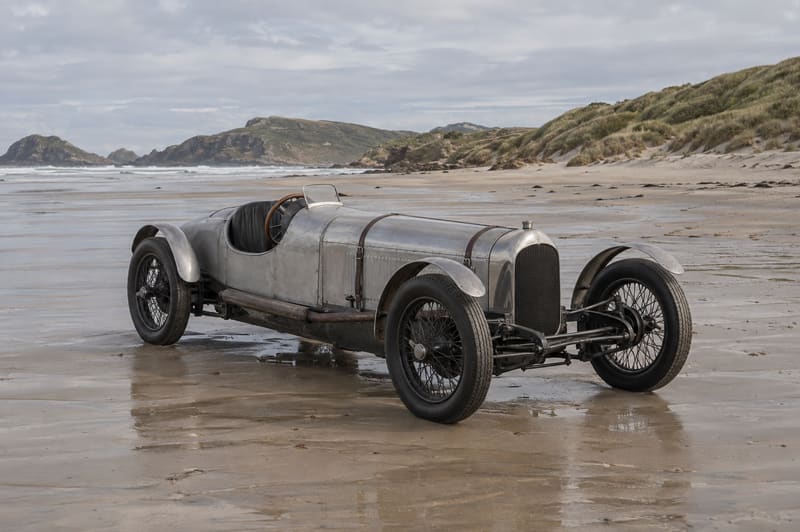
The recipe was gloriously simple. Take a V12 Liberty aero engine of 27 litres, good for 450 hp (340 kW). Add a gearbox and chain drive from a pre-war Blitzen Benz. Ask the coachbuilders at Bligh Brothers to wrap it in a body. The result was the largest capacity racing car ever to run at Brooklands.
Yes, 27 litres. No, that is not a typo.
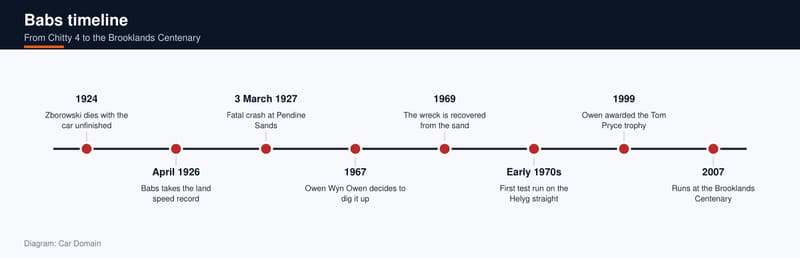
Zborowski never saw it finished. The car was still not fully developed when he died in 1924, and it was bought from his estate by a Welsh engineer named John Godfrey Parry Thomas for the sum of £125. It must be one of the most consequential £125 deals in the history of motor racing.
The engineer who walked away from Leyland
Parry Thomas was born in Wrexham on 6 April 1884, the son of the curate of Rhosddu. The family moved to nearby Oswestry when he was five, and he went to Oswestry School before studying engineering at the City and Guilds College in London.
A quick word on his name. You will often see it written as Parry-Thomas, with a hyphen. His Wikipedia biography is firm that his surname was simply Thomas. His family knew him as Godfrey, and he used Parry as his name for work and for racing. So Parry Thomas it is.
He became chief engineer at Leyland Motors, a company whose main products were commercial vehicles. After the First World War he and his assistant, Reid Railton, designed the Leyland Eight, a luxury car intended to compete with Rolls-Royce.
Then, in 1920, he drove it around Brooklands. That was enough. The experience persuaded him to give up his Leyland career and become a full-time racing driver and engineer.
He went into business inside the Brooklands circuit with Major Ken Thomson, an engineer from New Zealand, under the name Thomas Inventions Development Co. From 1923 he lived in the circuit's "flying village", in a bungalow converted from a First World War hut and named The Hermitage. He shared it with two Alsatian dogs and his cars, an ascetic life a long way from the hedonism of the Bentley Boys. It paid off on track: 38 race wins in five seasons, and numerous records.
How the Babs land speed car got its name
By 1925 Parry Thomas had realised that commercial success needed a higher profile than Brooklands could give him. The land speed record could provide it. The problem was money. Malcolm Campbell had wealth and prestige, and Henry Segrave had factory connections. Parry Thomas had neither, so he could not get hold of a brand-new Napier Lion engine, which the other record contenders were planning to use.
So he used what he could get: Zborowski's old Higham Special. He rebuilt it with new bodywork for better aerodynamics, and along the way it gained four Zenith carburettors and pistons of his own design. It was running in 1925, but it did not perform as expected.
He kept going. In April 1926 the car, now called Babs, emerged with another new body. Parry Thomas celebrated by driving it around the lanes near Brooklands that same evening, despite having no headlamps. Today that would end in an awkward chat with the local constabulary.
It has been rumoured that the high engine cover forced Parry Thomas to drive with his head tilted to one side. It is not true. Photographs show the driver could see straight ahead.
Pendine, the beach that became a speedway
Why a beach in Wales? By the 1920s, roads and race tracks were no longer adequate for land speed record attempts. As record speeds approached 150 mph (240 km/h), a car needed room to reach top speed before the measured mile and room to brake safely after it. That meant a smooth, flat, straight surface of at least 5 miles (8.0 km).
The beach at Pendine Sands, on the shores of Carmarthen Bay on the south coast of Wales, fitted the brief. Its firm, flat surface made a track straighter and smoother than many major roads of the time. Motor Cycle magazine called the sands "the finest natural speedway imaginable".
Malcolm Campbell was the first to use it for a world land speed record attempt, setting a record there on 25 September 1924 in his Sunbeam 350HP, Blue Bird.
In April 1926 it was Parry Thomas's turn. Conditions were poor and the sand was soft and wet, but a few days after that lamp-free evening drive he took the record anyway. The next day, 28 April 1926, he raised it to over 170 mph (270 km/h). The Babs entry on Wikipedia gives his record as 171.02 mph. It stood for almost a year.
The last run on 3 March 1927
Almost a year was all it got. In February 1927 Campbell raised the record to 174.22 mph (280.38 km/h) at Pendine with his second Blue Bird. Over the winter Parry Thomas had given Babs yet another body, with fairings partially enclosing the drive and the rear wheels.
On 3 March 1927 he went back to the same beach to win the record back. On his final run Babs went out of control at more than 100 mph (160 km/h) and rolled over. Parry Thomas was killed. He was the first driver to die in pursuit of the land speed record.
At the time, the blame fell on the right-hand drive chain, which was thought to have broken and struck him as the car rolled. The restoration decades later showed that could not have been the case. His biography says he was more likely killed by the injuries he suffered as Babs rolled and slid along the beach, and later investigation of the wreckage suggested a failure of the rear right-hand wheel may have caused the accident. The Pendine Sands entry calls the chain story an untrue urban myth.
He was buried in St Mary's Churchyard in Byfleet, Surrey, close to the Brooklands circuit where he had lived and worked.
Babs got a stranger farewell. After the inquest, its seats were slashed, the glass in its dials was smashed, and the car was buried in the sand dunes at Pendine. The sources do not say why. It sounds brutal today. To us it also feels oddly fitting: a record car laid to rest beside the beach that made it famous.
Forty-two years in the dunes
Babs stayed in the sand for some 42 years. Meanwhile the beach changed hands. The Ministry of Defence acquired Pendine Sands during the Second World War and used it as a firing range, and it still owns the beach, with prominent signs warning of unexploded munitions.
In 1967 Owen Wyn Owen, an engineering lecturer from Bangor, decided to excavate and restore Babs. Step one was finding it. The burial site was identified from old photographs, and it turned out to sit inside the perimeter of the MoD's Pendine military range.
The military authorities agreed to the dig on one condition: Parry Thomas's next of kin must not object. Tracking one down took Owen two years. He finally found a living relative, a nephew living in Walsall, and in 1969 the wreck came out of the dunes.
Not everyone cheered. The recovery was controversial at the time. The prevailing view was that the wreck could never be more than a pitiful museum display, and few expected it to resemble a car again, let alone run.
Rebuilding a car nobody thought could be saved
Those doubters had a point, at first. Babs was in very poor condition. Much of the bodywork had corroded, so a new body had to be built, melding in original material wherever possible. The mechanical running gear, though, was in good condition. Even the parts that could not be used were preserved well enough to act as patterns. The engine was salvageable, although many replacement parts had to be made from the original designs.
The work was done in Owen's garage at Capel Curig, and it took well over a decade.
Here is where we will stick our neck out. Some purists would call a car with a newly built body a replica wearing an old name. We think that is wrong. The engine, the running gear and the old parts used as patterns all came out of that hole at Pendine. Bodywork is the clothing. Babs is the same car, and in our view a more honest one than many glossy classics whose originality nobody ever questions.
If you are browsing classic cars for sale and wondering how much original metal a car needs to still count as the real thing, Babs makes a handy test case.
Towed to 60 mph by a Land Rover
The best bit came in the early 1970s, when Babs was first successfully tested on the Helyg straight. There was a catch. The gearing was so high that the only way to get Babs moving under its own power was a tow. So a local garage owner's Land Rover pulled it up to 60 miles per hour (97 km/h), and then Babs was bump-started.
A 27-litre land speed record car being towed into life by a Land Rover is our favourite image in this whole story. Anyone who knows the history of Land Rover in Australia knows the brand has done plenty of hard yards, but this has to rank among its odder jobs.
Babs was later demonstrated in front of the world press and television at an airfield near RAF Valley on Anglesey.
Where Babs lives now
For years Babs spent its summers on display at the Pendine Museum of Speed, until that building was demolished. A replacement, the Museum of Land Speed, has since opened at Pendine, and Babs is shown there for part of the year and at Brooklands Museum over the winter. In 2007 it ran at the Brooklands Centenary, a fitting outing for a car whose driver once lived at the circuit with his dogs and his cars.
After Parry Thomas died, the business he had started with Ken Thomson became Thomson & Taylor, and it went on to build cars such as Malcolm Campbell's Blue Bird. His old firm ended up building his great rival's car.
Owen's work was recognised in 1999 with the Tom Pryce trophy, engraved with the words Atgyfodwr Babs, or "Resurrector of Babs". He died in 2012, and since then his son has been the one driving the car.
For another adventure from motoring's past, our story of the 1953 Redex Trial and its little Peugeot is well worth a read. For sheer strangeness, though, we doubt anything beats a record car that spent 42 years underground and came back to run again.
Sources
- Wikipedia, Babs (car), accessed 12 November 2026
- Wikipedia, J. G. Parry Thomas, accessed 12 November 2026
- Wikipedia, Pendine Sands, accessed 12 November 2026


