
On the night of 25 July 1956, in thick fog off Nantucket, one of the boldest cars Chrysler ever commissioned was stowed below decks on an Italian ocean liner. The Chrysler Norseman was a four-seat fastback coupe built in 1956 as a concept car, with a roof that looked as if it was floating. It was meant to be a featured attraction of Chrysler's 1957 auto show exhibit in America. The next morning it went to the bottom of the Atlantic.
Hardly anyone ever saw it. The public never did, and neither did most of the stylists who worked on it. So one of the most daring dream cars of the 1950s is known today mostly through photographs and a list of specifications.
Virgil Exner and the Chrysler Norseman
Virgil Exner worked in Chrysler's Advanced Styling Group, and through the 1950s he gave the company cars that were lower, sleeker and more aggressive looking. He also cared a great deal about being able to see out. Exner wanted the best possible view in every direction from inside the car, and with the Norseman he pushed that idea as far as it would go.
Even the name was personal. The dream car was named for Exner's ancestry.
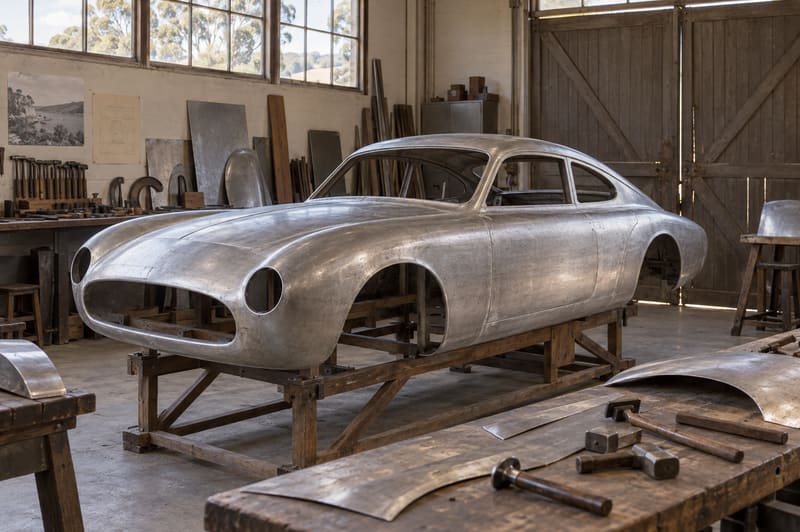
The Chrysler Corporation Engineering Division designed it. Building it was another matter, and that job went to Ghia of Turin, an Italian coachbuilder that already had experience making low-volume cars and one-off prototypes.
Chrysler wanted a car that could genuinely be driven rather than a rolling mock-up, so all the normal systems went in, from the powertrain to the brakes and suspension. Power came from a modified 331 cu in (5.4 L) Chrysler Hemi engine producing 235 hp (175 kW), hooked to a Powerflite automatic gearbox controlled by push buttons.
The body panels were aluminium. Up front, the bonnet sloped away sharply. At the back, the tail fins swept upward, and a long fastback met Chrysler's own take on fins and bumpers. Fins, a Hemi and push-button gears: it is hard to get more 1950s than that.
A roof that floated on glass
The roof is where the Norseman goes from handsome to properly strange.
It was cantilevered, fixed to the body only at the rear C pillars. There were no pillars down the sides. At the front, the roof rested only lightly on a windscreen that had no frame at all. No A pillars, no side pillars, just glass and a slim roof that seemed to hover over the cabin. This was visibility taken to its limit.
On top of that came a sunroof: a 12 square foot powered glass panel that slid open, set into a slender roof with no A pillar support at the front. Fitting it in was difficult, which will surprise nobody who has ever looked at a roof and wondered what holds it up.
The glass was special, too. PPG Industries made the windscreen and roof glass to be strong and shatterproof.
The door glass was ventless too, with no small vent window at the front of each door. That look would become popular some fifteen years later. The Norseman simply got there early, in a car the public would never see.
In our view, the roof is the real reason this car still matters. The fins were Chrysler's take on a familiar idea. A roof held on only at the back, on a car built to be driven, was something else entirely.
Clever ideas nobody got to try
Inside, the Norseman seated four in bucket seats, with a centre console running the full length of the cabin. The seatbelts were retractable reel-type belts mounted in the doors, and they fastened across the occupants to that long console.
That idea had a surprisingly long life. The arrangement was later adopted in the early 1990s to satisfy passive restraint regulations brought in by the US Department of Transportation. A belt layout from a car that sank in 1956 came back decades later as a way to meet the rules.
The gadget list kept going. The headlights were concealed and automatic. The door handles were concealed. Even the device for opening the boot lid was hidden away.
All of this took time and money. Building the Norseman, with its advanced features, took fifteen months. Its cost was estimated at US$150,000 in 1956 dollars. When it was finally done, the car was delivered to the freight forwarder, ready for the trip to America.
Read the spec sheet now and it feels like a list of things the industry would get around to later. We reckon that is what lifts it above a curiosity. It was not just pretty. It was early.
Ghia, the Turin coachbuilder that built it
If you needed a one-off built properly in the 1950s, Ghia was a good name to have on speed dial.
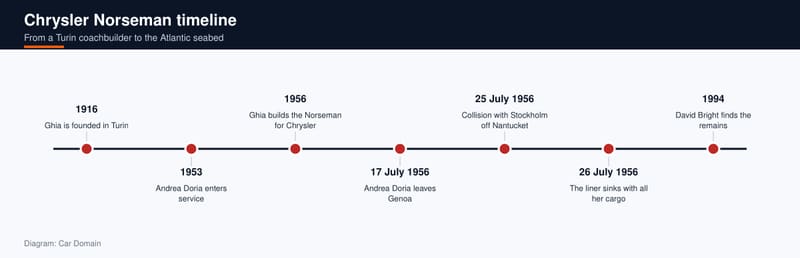
The company was established in Turin in 1916 by Giacinto Ghia and Gariglio, as Carrozzeria Ghia & Gariglio. It began with lightweight aluminium-bodied cars and found fame with the Alfa Romeo 6C 1500, which won the Mille Miglia in 1929.
Giacinto Ghia died in 1944, the firm changed hands, and ownership passed to Luigi Segre in 1954. Under Segre, between 1953 and 1957, Giovanni Savonuzzi helped make Ghia the most influential champion of the Italian styling that went on to shape car design around the world.
Chrysler and Exner became close partners of Ghia for 15 years. That relationship produced eighteen Chrysler Ghia Specials between 1951 and 1953, the K-310, the Norseman and the Imperial Crown limousines, among others.
There is a decent chance you know the name already, just not from this story. In 1970 Alejandro de Tomaso sold his shares in Ghia to the Ford Motor Company, and from 1973 the Ghia name became Ford's top trim level. In the Asia Pacific region it appeared on the Ford Laser, Fairmont, Fairlane and Telstar. So the Ghia name on an old Fairmont or Fairlane traces back to the same Turin firm that built the Norseman. You can read more in Ghia's long history as a coachbuilder.
The wrong ship
The plan was straightforward. Ghia would ship the Norseman from Turin to New York City in July 1956, and the car would star in Chrysler's auto show exhibit for 1957.
It did not go to plan. The car missed the cargo shipment it was meant to go on from Italy. Instead, it was put into a container on the next available ship, which happened to be the passenger liner SS Andrea Doria.
On paper, it was a classy way to travel. The Andrea Doria was a transatlantic liner of the Italian Line, put into service in 1953 and named after a 16th-century admiral from Genoa. Of all Italy's ships at the time, she was the largest, the fastest and supposedly the safest.
There was a weak spot, and the model tests had already found it. Model testing during her design predicted she would develop a huge list if she was hit by any significant force. On her maiden voyage she proved it, listing 28° after being hit by a large rogue wave off Nantucket.
Her final voyage was her 51st westbound crossing. She left Genoa on 17 July 1956, called at Cannes, Naples and Gibraltar, and then headed across the Atlantic towards New York with 1,706 people aboard. You can follow the whole voyage in the Andrea Doria's detailed history.
Fog off Nantucket
By 25 July 1956, the Andrea Doria was near the end of the trip, approaching the coast of Nantucket, Massachusetts. She had been travelling in heavy fog for hours. Coming the other way was the eastbound Stockholm of the Swedish American Line, roughly half the Andrea Doria's size.
Each ship knew the other was there only through radar, and they apparently misread each other's course. By the time the crews could actually see one another, they were far too close. Around 11:10 pm, the Stockholm struck the Andrea Doria's starboard side at almost a 90° angle.
The top-heavy liner began to list severely almost at once, which left half her lifeboats unusable. The ship stayed afloat through the night, and other vessels came to help, with the French Line's Île de France taking on 753 survivors, the largest share. In all, 1,660 of the 1,706 people aboard were rescued. A total of 51 lives were lost in the collision and sinking: 46 passengers from the Andrea Doria and five crew members of the Stockholm.
The evacuated liner capsized and sank the next morning, 26 July 1956. All of her cargo went down with her, including the Norseman and the other cars she was carrying.
Largely because of a confidential out-of-court settlement between the two shipping companies, signed during hearings straight after the disaster, no determination of cause was ever formally published.
A car almost nobody saw
The Wikipedia entry on the Chrysler Norseman calls it a "fascinating casualty" of the sinking, and that sums it up. The car was never shown to the public. Most of the stylists who worked on it never saw it. Automotive historians know it through photographs and specifications.
Here is our slightly contrarian take. Vanishing may have done the Norseman's reputation more good than a 1957 show stand ever could have. On that stand, in our view, it would have been one striking car among many. Lost at sea, it never had to prove its floating roof in the real world, and it never got old. A surviving car can rarely compete with that.
There is a curious postscript involving another car. Dick Teague worked for Chrysler as a stylist in the mid-1950s and was responsible for many of American Motors' vehicles. The Norseman's Wikipedia entry describes the car's resemblance to the 1965 Rambler Marlin fastback coupe, "or vice versa", as uncanny.
If the Norseman has you thinking about the brand's wider story, our piece on the history of Chrysler Australia is a good next read. And if a fastback you can actually drive appeals more, you can browse classic cars for sale, coupes for sale on Car Domain and current Chrysler cars for sale.
What the divers found
The wreck did not stay hidden for long. A week after the sinking, divers Peter Gimbel and Joseph Fox located it and published pictures in Life. The top of the wreck initially lay in 27 fathoms (49 m) of water, but the depth, water temperature and currents put it beyond the scope of recreational diving. It is a job for the most experienced technical divers, and it became known as the "Mount Everest of scuba diving".
In 1994, diver David Bright found the remains of the Norseman in the Andrea Doria's number two cargo hold. After almost 40 years below the surface, Chrysler's dream car had disintegrated into a pile of debris. Only the wheels were still recognisable. Fifteen months of work in Turin, and in the end a set of wheels in the dark.
The ship has kept coming apart, too. By 2010 the hull had fractured and collapsed, and the upper decks had slid off onto the seabed. The top of the wreck is now at 58 metres.
It is a dangerous place. At least 22 scuba divers have lost their lives diving on the wreck, and the liner's Wikipedia entry lists David Bright among them, in 2006.
So the Norseman survives the only way it can, as photographs, a specification sheet and a story worth retelling. It was built to show what was possible, it missed its boat, and it never arrived. Chrysler never tried that floating roof again, which makes those few photographs all the more precious.
Sources
- Wikipedia, Chrysler Norseman, accessed 11 November 2026
- Wikipedia, SS Andrea Doria, accessed 11 November 2026
- Wikipedia, Carrozzeria Ghia, accessed 11 November 2026


