
On 30 August 1953, huge crowds gathered at the Sydney Showground at Moore Park to watch 192 cars drive away. Not race away. Drive away, one every three minutes, on a loop of the whole country. This was the first Redex Trial around Australia, and it ended with a small French family car on top.
The winner was a Peugeot 203 crewed by Ken Tubman and John Marshall. It beat a Humber Super Snipe by a single point. We reckon that margin is the best bit of the whole tale, and we will get to why.
Where the Redex Trial began
The idea did not start big. It grew out of a series of car trials in New South Wales, sponsored by the British REDeX brand of oil additive and organised by the Australian Sporting Car Club of Sydney.
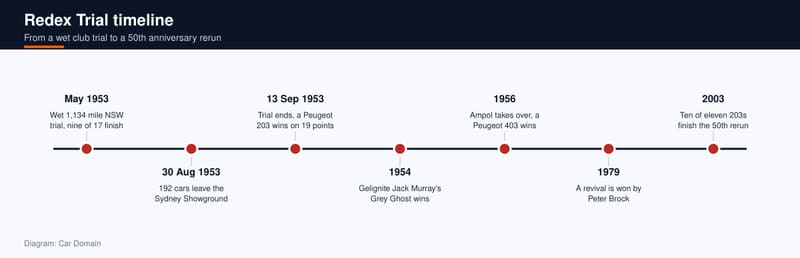
The first trials, in 1952 and February 1953, passed without much public attention. The second trial of 1953, run over 2 and 3 May, was different. It was billed as a 1,000 mile event, though the route actually ran to 1,134 miles. It left Sydney, climbed through the Blue Mountains, looped through country towns such as Cootamundra, Forbes, Orange and Mudgee, and came back down to the city.
Then the sky opened. In Sydney, 11 inches of rain fell, and only nine of the 17 competitors finished. A Ford Consul driven by Peter Antill won. Remember that name.
The rules were the clever part. A Redex trial was not a race. Crews lost points for arriving late at checkpoints, for the condition of the car at the finish and for a few other sins. The bonnets and radiator caps were sealed, and breaking a seal cost so many points that it was as good as disqualification.
In other words, you could not tinker your way out of trouble. The car simply had to last.
A route drawn around a continent
The round-Australia version took that idea and stretched it across the map. The 1953 Round Australia Trial ran from 30 August to 13 September, over 15 stages and 10,460 kilometres of tarmac and gravel. In the old measure, it was given as 6,500 miles.
The route was planned and test-driven by the club's secretary, Norman Pleasance. It ran north from Sydney to Brisbane, Rockhampton and Townsville, across the top to Darwin, down the middle through Alice Springs to Adelaide, and home through Melbourne to Sydney.
Smooth bitumen was not a given. The history of the Round Australia Trial notes that in the event's early years, the roads through large portions of the country were unformed, particularly west of Adelaide. That is exactly what made it such a test.
There was real money on the line, too. The first prize was £1,000, and entry was not restricted to members of car clubs. Anyone with a car and the nerve could have a go, which, we suspect, is a big part of why so many people cared.
The crowds who turned out
Public interest was intense, and every aspect of the trial became the subject of media attention. Over the week after the start, many hundreds of thousands of people took time to watch the competitors pass through towns along the route. The trial's Wikipedia history calls those early editions "heroic tests" and "front-page fodder" for the newspapers of the era.
Celebrity helped. Radio star Jack Davey, a pioneering star of Australian radio, was one of the first to enter when the trial was announced. He took a Ford Customline on the marathon with co-driver Lou Moss, and the results list his crew in 91st place. Not a podium, but he got around.
Not everyone loved the show. A common criticism was that some competitors drove at dangerously high speeds to win back time lost on a stage. Another was the edge enjoyed by sponsored teams. They had support crews along the way, and because the route was published in detail a month before the start, they could do a practice run in the weeks beforehand.
One figure gives the grumblers some ammunition. Of the top twenty finishers, two thirds were sponsored.
A field of very ordinary cars
Read down the results today and the entry list looks like a 1950s main street. There are Holden 48-215s all over it, along with Humber Super Snipes, Standard Vanguards, Ford Customlines, Austin A40s and MG TD Midgets.
A few European cars of real class mixed in. A Mercedes-Benz 170 D finished 15th. A Jaguar Mark VII came 46th, a Porsche 356 came 99th and an Allard M2X came 109th.
Then there are the glorious oddballs. A Ford 1932 V8 Roadster made it home in 132nd. A Renault 750, a Škoda 1101 and a Fiat 1400 all got around. A Nash 1928 Light Six, already a veteran, finished 140th. And a Holden 48-215 whose crew is listed as Jack Brabham, Bill Armstrong and Ron Tauranac came home 57th. Make of those names what you will.
This is why carmakers loved it. The event put their products through a particularly severe test and gave them a chance to prove their cars could cope with whatever remote Australia threw at them. A family sedan that survived a lap of the continent with its bonnet sealed shut said more than any brochure could.
In our view, that is what made it so watchable. Most of the field was the sort of car you might see parked outside the local servo, being asked to do something heroic.
The little Peugeot 203
The Peugeot 203 was a small family car, built from 1948 to 1960, and it was Peugeot's first new model after World War II. It was also the first production Peugeot with a monocoque body. Its shape bore a marked resemblance to the American Chevrolet Fleetline fastback, though it also reflected the streamlining trend in some of Europe's more modern designs.
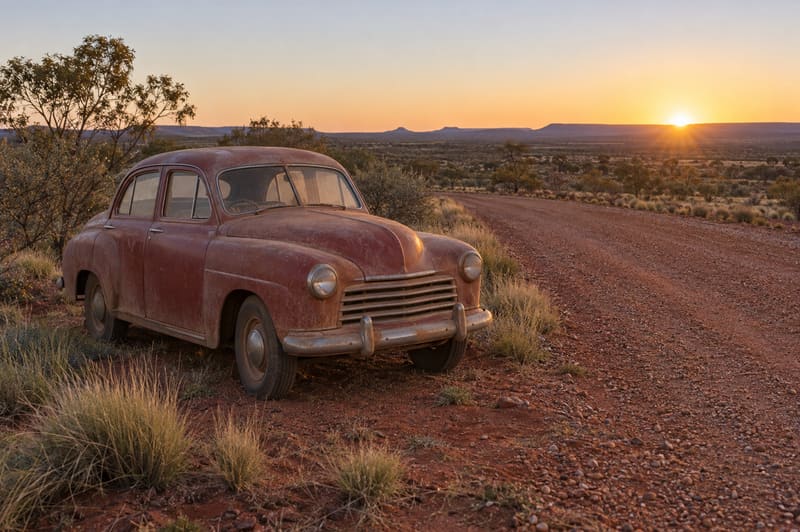
Under the bonnet sat a 1290 cc four-cylinder engine with unusual oversquare cylinders and hemispherical combustion chambers in light metal cylinder heads. Power was quoted at 31 kW at launch and 33 kW from 1952. The gearbox was a four-speed manual with a column change, and cars delivered between 1949 and 1954 had no synchromesh on the bottom ratio. Suspension was independent at the front by a transverse leaf spring, with coil springs and a Panhard rod at the back.
None of that reads like an outback weapon. But in France the practicality, price and reliability of the 203 won over plenty of motorists. In early 1954, it was noted that the 203 lost value in France more slowly than any other French car generally available, helped by a reliable, economical engine and an unusually tight turning circle.
It was no stranger here, either. The 203 went on sale in Australia in September 1949, and local assembly began in 1953, which made it the first Peugeot model to enter production in this country. The badge is still part of the story on our own pages, where you can browse Peugeot cars for sale today.
The 203 was having quite a year elsewhere, too. In 1953, Andre Mercier and Charles de Cortanze drove the Cape Town to Paris route, 15,000 km, in a record 17 days. That run sparked interest in the car's fuel economy: a single tank lasted 900 km, even on tough terrain.
How the Redex Trial was won by a point
Two weeks and 10,460 kilometres after the start, the scores were almost absurdly close. Ken Tubman and John Marshall, in car number 48 and entered as Team Tubman and Marshall, lost just 19 points.
Second place went to a John McGrath Motors Humber Super Snipe Mark IV crewed by Ken Robinson, Russell Lane and Anthony Peck, on 20 points. Third, on 21, was a 1952 Plymouth Concord crewed by Peter Antill, George Reed and Max Winkless. Yes, that Peter Antill, the man who had won the soggy May trial. The Preston Motors Holden 48-215 of Lex Davison, Peter Ward and Otto Stone was fourth on 22. Three points separated first from fourth.
The Peugeot was not a fluke, either. Two more 203s finished 12th and 14th. At the other end of the sheet, 142 crews were classified as finishers, and the last of them, a Holden 48-215, lost 3,169 points. It still got home.
Here is our slightly unpopular take. It is tempting to treat a win like this as proof of a superior car. We are not so sure. A single point is a tiny margin across a continent, and the Humber crew could fairly feel unlucky.
What the 203 really proved was endurance. Across 10,460 kilometres, it never got into enough trouble to lose more than 19 points. For a family car, we would argue that is a better advertisement than outright dominance. The Peugeot 203's own history agrees on the effect, at least: the win significantly raised the profile of Peugeot in post-war Australia.
What came after 1953
The success of the big lap did not end the shorter 1,000 mile Redex trials around New South Wales. The round-Australia event also came back bigger in 1954, at 9,600 miles, with a first prize of £2,000 and a route that truly circled the mainland, through Mount Isa, Darwin and Broome before swinging across to Adelaide.
In all, 246 cars took part. The winner was a 1948 Ford V-8, an ex-taxi dubbed the "Grey Ghost", driven by John "Gelignite Jack" Murray, who lost no points at all. He earned the nickname on that trial by occasionally setting off sticks of explosive to celebrate, a custom that delighted some and infuriated others. "Secret" checkpoints arrived the same year, in an attempt to curb speeding.
The 1955 trial sent 276 cars on a 10,500 mile loop, and more than half the field failed to finish, most of them beaten by the 379 mile stretch from Cairns to Hughenden. From 1956, Redex no longer sponsored the event, and Ampol took it over. The 1956 Ampol trial went to Wilf Murrell and Allan Taylor in a Peugeot 403 sedan, after 19,000 kilometres of rugged roads and tracks. Peugeot again.
By the 1960s, circuit racing, particularly the Bathurst 500 and the Tasman Series, had come to dominate Australian motorsport, and interest in the long trials waned. Still, the legend stuck around in odd places. The 1977 film Newsfront featured footage from the 1954 Redex Trial.
Fifty years on, the 203s went again
The Peugeot faithful never forgot. In 2003, Graham Wallis organised a 50th anniversary rerun of the 1953 Redex Round Australia Trial. Eleven Peugeot 203s started and ten finished, which, for cars of that age, strikes us as a fine result.
In 2006, about a dozen 203s, joined by other Peugeots, set off from Sydney again. That event was organised by Graham Wallis from the Peugeot Car Club of Victoria, this time to celebrate the 50th anniversary of that 1956 Ampol trial.
The big trial itself has had a few comebacks. A 1979 revival won by touring car star Peter Brock proved popular, but the next one did not come until 1995. The Round Australia Trial history says the event will return in 2029.
We hope it does. The appeal has not changed since Moore Park in 1953: an ordinary car, a very big country and the open question of whether one can get around the other.
If that idea tickles you, our classic cars for sale are a fine place to start dreaming. And if you want a tough family car for a long lap of your own, the family sedans for sale are the place to look.
Sources
- Wikipedia, Round Australia Trial, accessed 10 November 2026
- Wikipedia, 1953 Round Australia Trial, accessed 10 November 2026
- Wikipedia, Peugeot 203, accessed 10 November 2026
- Wikipedia, Jack Davey, accessed 10 November 2026


