
Maserati is one of the oldest names in Italian motoring, and its link with Australia goes back further than most buyers realise. A Maserati won the Australian Grand Prix at Albert Park in 1956, decades before the brand built a proper dealer network here 3.
This refreshed article replaces the original version, which repeated several claims we could not confirm. It covers how the company started and what it won on the track. It then follows its many owners and explains how Maserati Australia sells cars today.
A workshop in Bologna
Maserati was founded in Bologna on 1 December 1914 by Alfieri Maserati, one of a family of brothers with a shared passion for engines and racing 1. The early business prepared and built cars for others before it put its own name on a car. Alfieri himself lived from 1887 to 1932, and he was one of five Maserati brothers 8. His name returned a century later on the concept car Maserati built to mark its centenary 8.
The first car to carry the Maserati name was the Tipo 26, which made its debut at the Targa Florio road race in Sicily in 1926 1. Its trident badge was designed by Mario Maserati, one of the brothers, and was inspired by the statue of Neptune on the fountain in Bologna 1. Sources disagree about whether the family first used the trident in 1920 or only on the 1926 car, but it has been the company's emblem ever since 1.
In 1937 the Orsi family bought the company, and soon afterwards the headquarters moved from Bologna to Modena, where Maserati is still based 1.
Racing made the name
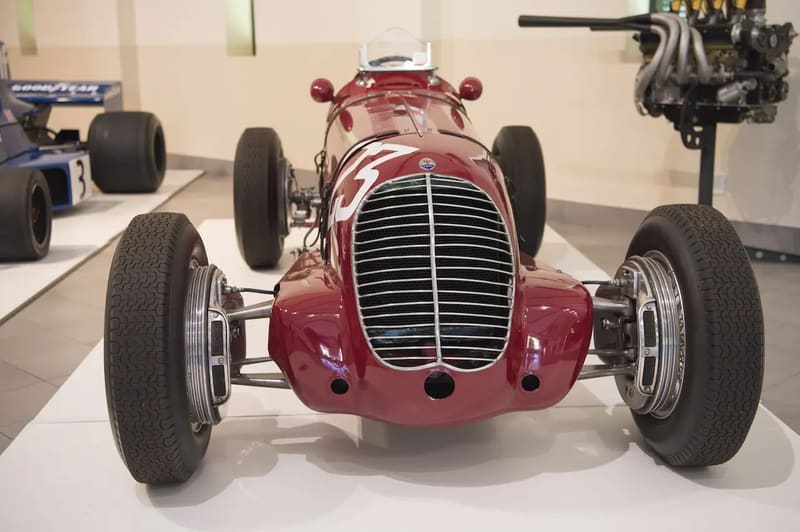
Maserati's reputation was built on the track. Its most famous racing car, the 250F, was used in the 2.5-litre era of Formula One from January 1954 to November 1960 2. Most examples used a 2,493 cc straight-six engine producing about 220 bhp, and only 26 were made 2. Later works cars tried a 2,491 cc V12 instead 2. Production of the car ran from 1954 to 1958 2.
The 250F won two drivers' world championships, both for Juan Manuel Fangio, in 1954 and 1957 2. It also took eight Formula One race wins in all 2. Private owners kept racing 250Fs long after the works team moved on, which is one reason the car became such a familiar sight at races around the world, Australia included.
Maserati at the 1956 Australian Grand Prix
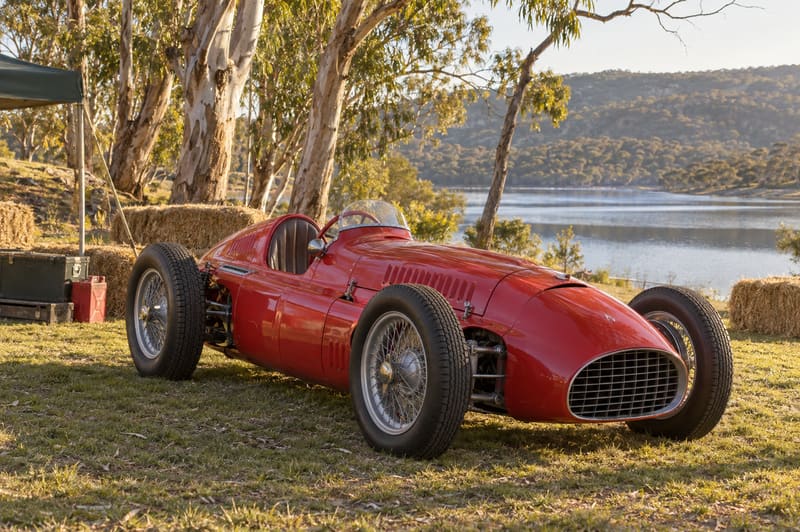
The best known Maserati moment in Australia came on 2 December 1956. That year the Australian Grand Prix was held at the Albert Park street circuit in Melbourne, moved to the end of the year to make the most of the publicity around the Melbourne Olympic Games 3.
The race ran over 80 laps, about 402 km, and Maseratis dominated it 3:
- Stirling Moss won in a Maserati 250F 3;
- Jean Behra finished second in another 250F 3;
- Australians Reg Hunt and Stan Jones took fourth and fifth, both also driving 250Fs 3.
Two other Maseratis started and did not finish 3. For a small Italian factory, it was a remarkable show of strength on the other side of the world, and it gave Australian racing fans a close look at the cars they had only read about.
Albert Park had hosted the Australian Grand Prix once before, in November 1953, and the 1956 race was the second weekend of a meeting that began on 25 November 4. The parkland circuit then dropped off the grand prix calendar for decades. The Formula One Australian Grand Prix has been held there every year since 1996, and the current layout, used since 2021, is 5.278 km long 4. Anyone who has watched a modern grand prix in Melbourne has seen the same park where a Maserati won in 1956.
An Australian 250F with a famous family
One of the local 250F drivers at that race had a long connection with the car. Stan Jones raced a Maserati 250F in Australian events from 1956 to 1959 5. He won the New South Wales Road Racing Championship in it in 1956 5. He finished third in the Australian Drivers' Championship in 1957 and won that title in 1958 5. He also won the 1959 Australian Grand Prix 5.
His son, Alan Jones, became Formula One world champion in 1980 5. The family's racing story, in other words, began in part behind the wheel of a Maserati.
Many owners, one badge
Maserati has changed hands more often than most carmakers. Citroen took it over in 1968 1. When Citroen announced its liquidation in May 1975, an agreement that August put Alejandro de Tomaso in charge 1. Fiat became sole owner on 19 May 1993, after buying De Tomaso's 51 per cent stake 1.
The next steps tied Maserati to Ferrari, and then pulled it away again. Fiat sold half of Maserati to Ferrari in July 1997, and Ferrari took full control in 1999 1. In 2005 Maserati was separated from Ferrari and paired with Alfa Romeo inside the Fiat Group 1. Since the formation of Stellantis in 2021, from the merger of Fiat Chrysler and PSA, Maserati has been part of that group 1.
How Maserati Australia sells its cars
Unlike most big brands, Maserati has not set up a factory-owned company to run its Australian business. Since October 2005 its cars have been imported and distributed in Australia and New Zealand by European Automotive Imports, part of the Ateco Group 6.
In 2014 Maserati confirmed it would stay with that arrangement. Ferrari had moved to its own factory operation, Ferrari Australasia, in April 2013, but a Maserati executive said there was no need to change something that worked 6. By 2021 GoAuto still described Ateco Automotive as the parent company of Maserati Australia and New Zealand 7.
Sales here have always been small. Maserati sold 134 cars in Australia in 2013 6. At that time it was planning a much bigger range, with a target of 1,500 Australian sales a year and plans for a network of eight Australian dealerships 6. The Ghibli sedan had just launched, and the Levante SUV was on the way 6.
The car that did not arrive
The same 2014 plan promised the Alfieri, a two-seat coupe named after the company's founder and shown as a concept at the 2014 Geneva Motor Show for Maserati's centenary 8. Its launch kept slipping, first to 2020 at the earliest and then to 2021 or 2022, and production had still not started after the Stellantis merger 8. Some of its styling later appeared on a new GranTurismo prototype reported in testing in mid-2021 8.
Maserati today
The modern Maserati range is smaller and more focused. The mid-engined MC20 sports car made its debut in September 2020 1. In March 2022 the company announced that every model would get an electric version by 2025 and that it aimed to stop selling combustion cars by 2030, with its electric models carrying the Folgore name 1.
The numbers show how hard the last few years have been. Maserati's worldwide shipments were 26,600 in 2023, 11,300 in 2024 and 7,900 in 2025 1. Those are global figures for the whole company, and they show a brand much smaller than the one it was a few years ago.
Buying a Maserati in Australia
A Maserati is an emotional purchase, and it pays to go in with clear eyes. If you are looking at a new or near-new car, check the exact model and year on the ANCAP website, which publishes independent crash test results for new cars sold here 9. If the model you want is not listed, ask the seller what safety testing it has had. Before you buy, also find out where the nearest authorised service centre is, since a long drive for every service adds up.
Running costs deserve a hard look. A performance car with a large engine and big brakes will cost more to service, insure and fit with tyres than an everyday car, and those costs do not fall just because the purchase price of a used example has. Get a quote for insurance and for the next major service before you agree on a price, and have the car inspected by a specialist who knows the model.
On the used market, a full service history matters more than usual. Our guide to why you should never skip a scheduled service explains why. If you want the Italian background, our Maserati and Ferrari parts cross-reference covers the shared engineering of the Ferrari era, and our list of the most expensive cars shows where the trident sits in the luxury market.
When you are ready, browse cars for sale on Car Domain, use our car loan calculator to check repayments, and read our buying safety tips before you pay a deposit. For more on the race that put Maserati on the map here, see the 1956 Australian Grand Prix record, and the Maserati company history for the full list of owners.
Sources
- Wikipedia, Maserati, accessed 2 November 2026
- Wikipedia, Maserati 250F, accessed 2 November 2026
- Wikipedia, 1956 Australian Grand Prix, accessed 2 November 2026
- Wikipedia, Albert Park Circuit, accessed 2 November 2026
- Wikipedia, Stan Jones (racing driver), accessed 2 November 2026
- GoAuto, Maserati to stick with Aussie distributor, accessed 2 November 2026
- GoAuto, New general manager for Maserati Aus, accessed 2 November 2026
- Wikipedia, Maserati Alfieri, accessed 2 November 2026
- ANCAP, ANCAP Safety, accessed 2 November 2026


