
Mazda trucks have a longer history in Australia than many drivers realise. Most people think of the brand's passenger cars, yet Mazda began as a maker of load carriers and has sold light trucks here since 1964 2.
The first version of this post leaned on recollections and estimates that could not be checked. This refreshed history keeps to what the records show. It covers the B-series light trucks and the heavier Titan with its Australian Ford twin. It then follows the E-series vans and the BT-50 ute that carries the badge on worksites today 1.
A company that started with a truck
Mazda's first vehicle was not a car. In 1931 it built the Mazda-Go, a three-wheeled truck that Mazda Australia describes as the company's first ute-type vehicle 1. It could carry 200 kg, and 66 were built 1.
The step to four wheels came in 1950, with the Type-CA, a small truck with a one-tonne load capacity 1. The model that would matter most to Australia followed in August 1961: the B1500, the first of Mazda's B-series light pick-ups 1.
The B-series arrives in Australia
According to GoAuto's model history, Mazda has sold B-series light trucks in Australia since late 1964, and continuously from 1967 2.
The early B1500 was a simple machine: a separate chassis, a two-seat single cab and a one-tonne rating 2. Its 1.5 litre overhead-valve four-cylinder made 52 kW and 118 Nm, driving the rear wheels through a four-speed manual with a floor shifter 2. Twin headlights arrived in March 1966 2.
The range grew in steps:
- B1600, September 1971: a larger 1.6 litre engine rated at 70 kW and 136 Nm 2.
- B1800, October 1977: a 1,000 kg payload model that replaced the B1600 2.
GoAuto lists four generations of the B-series Bravo in Australia, dated October 1964, October 1978, June 1985 and February 1999 2.
The last of the Bravos
The final B-series, sold here as the Bravo, was built in Thailand and shared its design with the Ford Courier 3. GoAuto's records show a facelift in November 2002 and a V6 added from late 2005 3. The 2.5 litre turbo-diesel B2500 made 86 kW and 280 Nm, and a 2.6 litre petrol B2600 made 92 kW 3. The Bravo was discontinued in November 2006 3.
The Titan: the bigger Mazda trucks
Above the B-series sat Mazda's medium-duty trucks. The line started with the E2000 in 1964, and a 2.5 litre diesel E2500 followed in 1970 4.
In 1971 Mazda replaced the E2000 with the Titan 4. Its generations ran:
- first, 1971 to 1980: a 2.5 litre diesel carried over from the E2000, a 2.7 litre diesel option and a 2.0 litre petrol four, with a 3 litre diesel from 1977 4;
- second, 1980 to 1989: a 4,052 cc six-cylinder diesel joined the four-cylinder engines 4;
- third, 1989 to 2000: later fitted with Isuzu engines to meet 1994 emissions rules 4.
In export markets the second generation was sold under names such as T2000, T2500, T3000 and T4100 4, and the third generation was sold as the Mazda T series 4. Those T numbers are the ones many Australian operators remember from council depots and small transport firms.
The Titan also carried people. Its first-generation chassis was shared with the Parkway minibus, and a new Parkway based on the second-generation Titan arrived in January 1982 4. That shared hardware is why old Mazda buses and Mazda trucks often turn up side by side in wreckers' yards.
When a Titan was a Ford
The Titan has a uniquely Australian side. Its first generation was the basis for an Australian-market 3 tonne truck sold as the Ford Trader 4. A later Ford Trader 0409 appeared in Australia from 1989 to 1998 4, and the third-generation Titan was sold in export markets both as the Mazda T series and as the Ford Trader 4.
Buyers could have a third-generation truck with a ute-style bed or a tray top, and a box with a hydraulic lifting tray was also offered 4, which explains why so many ended up as tippers and tradie trucks.
Mazda hands the job to Isuzu
From June 2004 the Titan became a rebadged Isuzu Elf 4. That ended Mazda's own design work on medium trucks, and in Australia the Mazda badge faded from that end of the market. Operators who wanted a Japanese medium truck after that bought from the makers that kept building their own, and the Mazda name lived on mainly through older trucks still at work.
The E-series vans and light trucks
Between the B-series and the Titan sat a third family: the Bongo, sold in export markets as the E-series. In Australia it was sold under the E-series and Traveller names, and Ford sold rebadged versions too 5. The best known was the Ford Econovan, sold from the second generation onwards 5. A passenger version, the Ford Spectron, was sold from 1983 5. In 1986 the long Maxi versions of the Econovan were offered with a four-wheel-drive option 5, and in December 1985 Ford updated the engines to run on unleaded petrol 5.
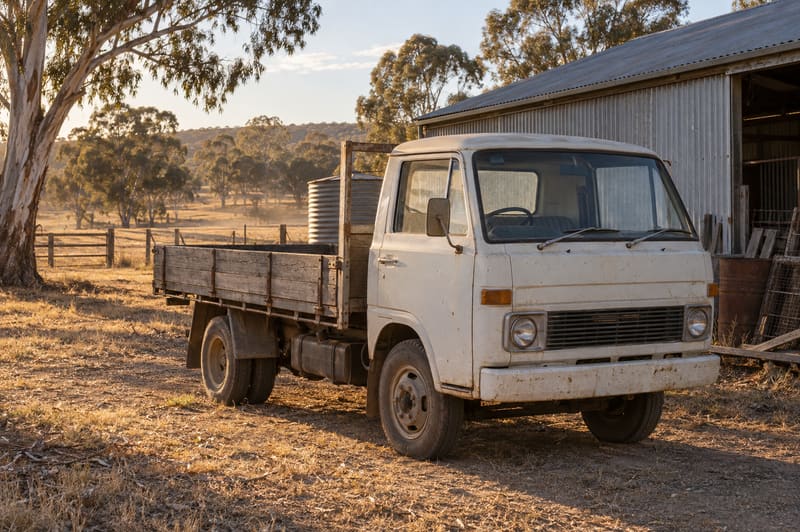
The export names tracked engine size, from the E1300 and E1400 to the E2000 and E2200 5. The last Australian version, the E1800, was discontinued here in 2006 5.
In March 2012 Mazda announced that the fourth-generation Bongo would be its last in-house van and truck design, and that it would withdraw from commercial vehicle production to focus on fuel-efficient passenger cars 5.
From B-series to BT-50
Mazda did not leave the work-vehicle market altogether. It moved its effort into one-tonne utes, the same job the B-series had done in Australia since 1964 2. The BT-50 name arrived with the first generation in 2006 and replaced the B-series name 1. Mazda Australia counts the 2024 range as the third generation to wear it 1.
Each BT-50 generation has been built in partnership with another maker 6:
- First generation, 2006 to 2011: launched at the Bangkok motor show in March 2006, sharing its diesel engines with the Ford Ranger 6.
- Second generation, 2011 to 2020: revealed at the Australian International Motor Show in October 2010, based on the Ford Ranger, with its body designed by Mazda's team at Ford Australia's Melbourne design centre 6.
- Third generation, from 2020: unveiled in Australia on 17 June 2020 and based on the Isuzu D-Max, built by Isuzu in Thailand 6.
Australia is one of the BT-50's biggest markets 6. The current model launched here in October 2020, and Wikipedia's sales table lists 15,164 Australian sales in 2024 6.
So the story has come full circle. In the 1990s Mazda trucks were sold as Fords. Today Mazda's work ute is built by Isuzu 6, the same company whose trucks eventually took over the Titan 4.
Where the trucks worked
Mazda's trucks earned their keep in ordinary jobs rather than headline ones. The tray tops and tipping bodies of the third-generation Titan 4 suited builders and councils as well as delivery operators, while the B-series was a one-tonne workhorse for tradespeople and farmers 2.
Their legacy shows in the vehicles that replaced them. Medium trucks in Australia today mostly come from makers that specialise in them. The size and weight limits they must meet are set out in our guide to the legal size limits of trucks. If you work with bigger rigs, our explainer on the different types of semi-trailers covers the trailers they pull.
Buying an old Mazda truck or ute today
Older Mazda trucks and utes still turn up for sale, and some have a following among collectors and tradies. Many are now decades old, so judge each one on its condition rather than its badge, and budget for repairs before you agree on a price. If you are looking at one, a few checks are worth doing:
- Rust and chassis: check the chassis rails, cab mounts and tray mounts carefully, because a separate-chassis vehicle can hide corrosion under the body.
- Engine history: ask what work the engine has had, and whether a diesel has been swapped or rebuilt.
- Parts: check that the parts you are likely to need are still available before you commit.
- Paperwork: do a vehicle status check before you pay. Consumer Affairs Victoria says a PPSR check for money owing costs $2 7, and a VicRoads vehicle report can show past roadworthy results, recorded odometer readings and whether the vehicle is listed as stolen or written off 7.
For private sales, Consumer Affairs Victoria advises sighting the car and its VIN or chassis number in person where you can 7. Our safe buying guide covers the scams to watch for, and you can browse cars and utes on Car Domain.
More Mazda history
Mazda's commercial vehicles are only one part of its Australian story. The trucks explain why the brand still has a ute in its range when it has dropped vans and medium trucks, and why its current work vehicle comes from a partner rather than its own factories 6. Our wider history of Mazda in Australia covers the cars, and our report on Mazda's plans to reinvent the engine looks forward rather than back.
You can read Mazda Australia's own BT-50 history notes and the Mazda Titan entry on Wikipedia for more on the trucks themselves.
Sources
- Mazda Australia, The Mazda BT-50: did you know?, accessed 2 November 2026
- GoAuto, Mazda Mk1 B Series Bravo, accessed 2 November 2026
- GoAuto, Mazda Bravo, accessed 2 November 2026
- Wikipedia, Mazda Titan, accessed 2 November 2026
- Wikipedia, Mazda Bongo, accessed 2 November 2026
- Wikipedia, Mazda BT-50, accessed 2 November 2026
- Consumer Affairs Victoria, Vehicle status check, accessed 2 November 2026


