
Owners of Maserati and Ferrari cars from the 2000s often discover that Maserati and Ferrari parts overlap: a part for one brand turns up, under a different number, in the other. That is not a coincidence. For several years the two companies were under the same roof and shared an engine family, and with it many of the parts that surround an engine.
An earlier version of this post was a table of part numbers that a reader could use to find cheaper equivalents. We could not check each of those numbers against a primary source, and a wrong part number on an expensive car can cost far more than it saves. So this refreshed version explains why the parts overlap, which cars are involved and how to cross-reference a part safely yourself.
Why Maserati and Ferrari parts overlap
The overlap starts with ownership. In 1997 Fiat sold a 50 per cent share of Maserati to Ferrari, which Fiat itself owned 2. In 1999 Ferrari took full control and made Maserati its luxury division 2.
That arrangement did not last forever. In 2005 Maserati was split off from Ferrari and partnered with Alfa Romeo within the Fiat group 2. Maserati has been owned by Stellantis since 2021 2. But the engineering decisions of the Ferrari years lived on in the cars for much longer.

The F136 engine family
The most important shared component is a V8. The F136 engine family was jointly developed by Ferrari and Maserati and produced by Ferrari 1. Production started in 2001, and the family came in sizes from 4.2 litres to 4.7 litres 1.
It powered a long list of cars 1:
- Maserati: the Coupe, the Spyder, the GranSport and GranSport Spyder, the Quattroporte, the GranTurismo and the GranCabrio 1;
- Ferrari: the F430 and F430 Spider, the California and California 30, and the 458 Italia and 458 Spider 1;
- Alfa Romeo: the 8C Competizione and the 8C Spider 1.
The family was eventually replaced by Ferrari's twin-turbo F154 engine, starting with the 2013 Maserati Quattroporte GTS and the 2014 Ferrari California T 1. That means the overlap discussed here applies mainly to cars from the early 2000s to the mid 2010s.
A closer look at the Maserati Coupe
The Maserati Coupe and Spyder show how deep the sharing went. Both use the F136 R V8, a 4,244 cc engine rated at 390 PS 3. The design changed because the powertrain was now based on Ferrari's 3.
Many of these cars also used an automated manual gearbox called Cambiocorsa. It is a six-speed unit built by Graziano Trasmissioni with a Formula One style design 3. It is operated hydraulically and managed electronically, and the driver shifts with paddles behind the steering wheel 3. The sportier GranSport made its debut at the Geneva Motor Show in March 2004 with 400 PS 3. In all, 13,423 cars were built before the GranTurismo replaced them 3.
For owners, that shared engineering is good news. Engine sensors and ignition parts, along with the hydraulic pumps that run automated gearboxes, are the kinds of components that may be common across these models. But "may be" is the important phrase, and the only way to be sure is to check each part.
Why a part can have several numbers
Carmakers rarely make every component themselves. Many electrical and engine management parts are made by specialist suppliers and fitted by several carmakers. The same physical part can then carry the carmaker's own part number, a different number from a second carmaker, and the supplier's own catalogue number.
That is how a cross-reference list works. If two carmakers' numbers lead back to the same supplier part, the parts may be identical, and the supplier's version, sold in its own packaging, may cost less than the one in a carmaker's box. The original version of this post listed parts of exactly this kind, including:
- mass air flow sensors and oxygen sensors;
- ignition coils and spark plugs;
- throttle bodies, fuel injectors and fuel pumps;
- the hydraulic pump for the automated gearbox.
The catch is that a matching shape, or a similar number, is not proof. Suppliers revise parts, carmakers specify different calibrations, and a part that fits physically may not suit the car's engine management.
Genuine, supplier and aftermarket parts
It helps to be clear about the three kinds of part you will be offered.
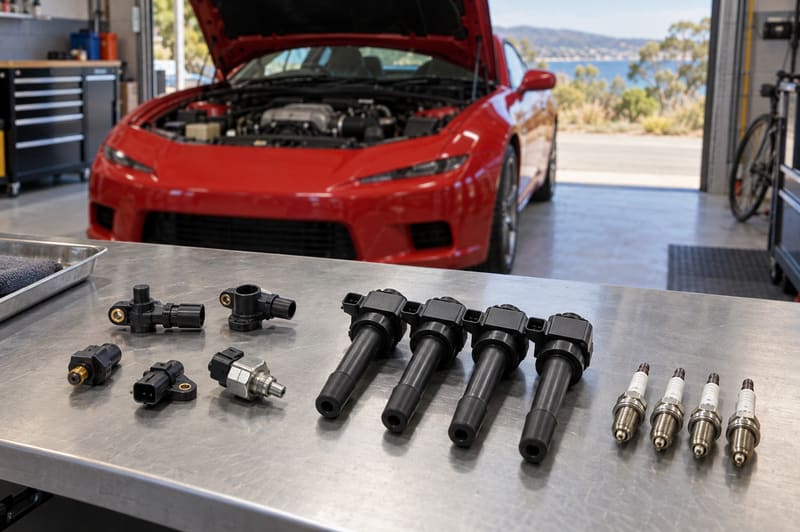
- Genuine parts come in the carmaker's own packaging with the carmaker's part number. They cost the most, and they are what a franchised workshop will usually fit.
- Supplier parts are made by the company that supplies the carmaker, sold under the supplier's own brand and number. When the part really is the same, this is where the savings in a cross-reference list come from.
- Aftermarket parts are made by other companies to fit the car. Quality ranges from excellent to poor, and they are not the same part, even when they fit.
None of these is automatically right or wrong. For a part that affects how the engine runs or how the car stops, it is worth paying for certainty. For a simple consumable, a well-known supplier part can make good sense. The key is to know which kind you are buying, and to make that choice on purpose rather than by accident.
How to cross-reference a part safely
If you want to find an equivalent part, work through these steps before you order:
- Start with the car's identity. Note the vehicle identification number, the model and the exact year. Engines and parts changed during production runs.
- Read the old part. Most parts carry the carmaker's number and, often, the supplier's own number. Photograph both before you remove anything.
- Check the supplier's catalogue. Look up the supplier's number in its own catalogue and confirm that it lists your car, not only a similar one.
- Compare everything. Connectors, mounting points, calibration codes and revision letters all matter.
- Buy from a reputable seller. Counterfeit parts exist, especially for high-value brands. A price that looks too good is a warning sign.
- Keep records. Note what you fitted and where it came from, for your own servicing history and for the next owner.
Plan for the part being wrong, too. Before you order, check the seller's returns policy for parts that have been opened or fitted, because electrical parts in particular are often hard to return. If a replacement does not fix the fault, or brings up a new warning light, refit the old part or the original-specification part and have the car checked rather than trying a string of alternatives.
If the car is still under a manufacturer's warranty, read the warranty terms on servicing and parts before fitting anything that did not come from the maker. When in doubt, ask a specialist workshop that knows the model.
Your right to repair information
Australian law now helps independent workshops get the information they need. The Motor Vehicle Service and Repair Information Sharing Scheme requires data providers to make service and repair information available for purchase at a fair market price 4. The data providers are usually the car manufacturers 4. It covers passenger and light goods vehicles built from 2002 onwards 4.
Access comes with limits. Information related to safety and security is only available to people who meet specified access criteria 4. The scheme began in July 2022 5. A government review has associated it with a $2,400 million increase in automotive industry turnover each year 5.
For owners of Italian exotics, that matters. A good independent specialist can buy the same repair information as a franchised workshop, which gives you more choice about who looks after your car and which parts they fit.
Buying a Maserati or Ferrari from this era
If you are looking at a car that uses the F136 engine, the shared parts story is a point in its favour, but it does not replace a proper inspection. Ask for the full service history, check how the automated gearbox has been maintained, and have the car inspected by someone who knows the model.
Browse cars for sale on Car Domain and read our buying safety tips before you commit. For more on high-performance cars, read about South Australia's special licence for powerful cars and the story of the flood-damaged McLaren P1. The Wikipedia entry for the F136 engine lists every car that used it, and the Treasury fact sheet explains the repair information scheme.
Sources
- Wikipedia, Ferrari F136 engine, accessed 2 November 2026
- Wikipedia, Maserati, accessed 2 November 2026
- Wikipedia, Maserati Coupé, accessed 2 November 2026
- The Treasury, Australian Government, Fact sheet: Motor Vehicle Service and Repair Information Sharing Scheme, accessed 2 November 2026
- The Treasury ministers, Right to repair delivering for motorists, small business and the economy, accessed 2 November 2026


