
Thirty-four seconds. That is how long it took, on a spring day in 1899, for a Belgian engineer perched on a metal torpedo full of batteries to cover a kilometre of road at Achères, near Paris. The car was La Jamais Contente, and that run made it the first road vehicle to go faster than 100 km/h. It ran on electricity. It had no proper brakes. And it was built for a reason that sounds almost comically ordinary now: its creator wanted to sell more electric carriages than the other bloke.
The story behind it is a real duel between a red-bearded Belgian and a French count, who swapped the land speed record back and forth over a few short months like two schoolboys trading cards.
A cab war fought with stopwatches
Paris in the late 1890s looked like a promising place to sell electric carriages. The rechargeable lead-acid battery, invented by Gaston Planté in 1859, had made them possible, and electric vehicles were easier to start and more reliable than the early petrol machines. In the United States, electrics would go on to hold a third of the car market between 1900 and 1910.
Camille Jenatzy wanted his share. His father, Constant Jenatzy, made rubber products at a time when rubber was still a novelty. Camille studied as an engineer and took a keen interest in electric traction. Hoping to carve out a place in the Parisian electric carriage market, he started a manufacturing plant that would go on to build many electric carriages and trucks.
His great rival was Jeantaud. Charles Jeantaud was a coachbuilder who had built his first electric carriage back in 1881, and cars carried the Jeantaud name in Paris from 1893. The two firms fought hard in publicity stunts, each trying to show it made the fastest vehicles. Speed, in other words, was the marketing department.
In our view this is the most likeable part of the whole saga. The first duel for the land speed record was not really about national pride or engineering glory. It was about who would win the cab trade, and the stopwatch was simply the loudest advertisement going.
The count who set the first land speed record
Jeantaud had a quick driver on its side. Count Gaston de Chasseloup-Laubat was a Paris-born aristocrat, the son of a Navy minister under Napoleon III, and he already knew how to win. In 1897 he took the Marseille to La Turbie long-distance race in a steam vehicle built by Trépardoux & Cie, the firm that came before De Dion-Bouton. It was the only major city-to-city event won by a steam car.
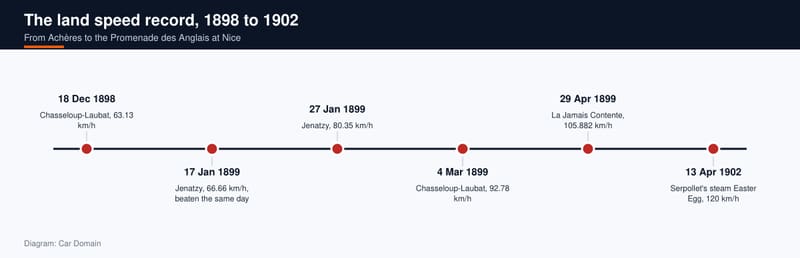
On 18 December 1898, at Achères in Yvelines, he drove a Jeantaud electric car to the first recognised automobile land speed record. The run was part of a competition organised by the French magazine La France Automobile. He made a single flying run over one kilometre in 57 seconds, an average of 63.13 km/h.
Note the word single. Modern rules would never accept it. Today a record is measured over a kilometre or a mile and averaged across two runs in opposite directions within one hour, and a new mark has to beat the old one by at least one percent. Back then the record had no official regulator. The first, the Automobile Club de France, only proclaimed itself arbiter of the record in about 1902.
We think the count deserves far more fame than he gets. He set the first mark, he kept raising it, and he was the man Jenatzy had to beat.
Four months of trading blows at Achères
Jenatzy answered on 17 January 1899, on the same ground at Achères. Driving a CGA Dogcart, he reached 66.66 km/h over one kilometre. It lasted no time at all: Chasseloup-Laubat broke the record that same day.
Ten days later, on 27 January, Jenatzy took it back at 80.35 km/h.
The count's reply was clever. He gave his Jeantaud some rudimentary streamlining. The firm's 1899 record car, the Duc Profilée, was designed to be more aerodynamic than its older brother, with pointed ends at both the front and the back. On 4 March 1899 Chasseloup-Laubat pushed the record to 92.78 km/h.
Counting the count's December mark, that is five records in less than three months, each one an advertisement for somebody's carriage business. Jenatzy's answer was to build a car with a single purpose.
A torpedo made of partinium
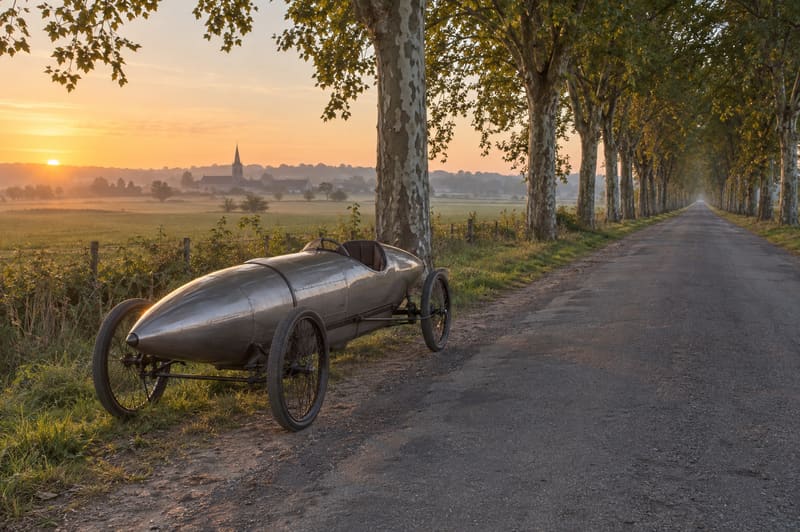
The result was a bullet-shaped prototype, the first purpose-designed land speed racer. Its body was conceived by the carriage-maker Rothschild, the firm of J. Rothschild & Fils, and made from partinium. That light alloy is described as a mix of aluminium, tungsten and magnesium. Described is the key word: one metallurgical analysis found no trace of the tungsten.
The body was shaped like an artillery shell, 3.80 metres long. Underneath, the chassis came from a cab. It was chassis number 25, and the car is also listed as CITA Nº 25.
Now for our slightly unpopular opinion. The torpedo is the image everyone remembers, and we reckon it is the most overrated part of the car. Jenatzy sat high up on top of it, and the chassis was left exposed underneath. According to the car's encyclopaedia entry, that high driving position and the bare chassis spoiled much of the aerodynamics.
So the pointy shell looked the part, but it was never the slippery missile of legend. The record was won by something less glamorous: a lot of electrical muscle, and a driver willing to use it with almost nothing to slow him down.
Two motors, a hundred cells and hardly any brakes
That muscle came from two Postel-Vinay motors of 25 kW each, mounted at the back between the wheels. Each drove the rear axle through a chain. They ran at 200 V and drew 124 A each, for about 68 hp in total. Feeding them were Fulmen batteries, 100 cells of 2 V, which made up nearly half of the car's total weight of 1,450 kg.
Here is the comparison that matters most to us. The Duc Profilée had a single electric motor of 26.8 kW and weighed around 1,400 kg. Jenatzy turned up with close to twice the power in a car of much the same weight. Streamlining or not, that was always going to hurt.
The controls are the part that makes a modern driver wince. There was no steering wheel. Two levers did that job, with an accelerator pedal for the motors. It could even reverse, thanks to a reversing switch. What it did not have was brakes in any sense we would recognise. The only help came from two drums on the rear wheels, worked by cable, which acted as a retarder more than anything that would pull it up in a hurry.
It rolled on Michelin tyres, a fitting detail for the son of a rubber manufacturer. And all those cells make us smile whenever the modern debate turns to what happens to old electric car batteries. Jenatzy had a hundred of them to worry about.
How La Jamais Contente broke 100 km/h
The decisive day was 29 April 1899, though one account gives 1 May. La France Automobile organised a speed contest on the central road of the agricultural park at Achères, a strip 2 km long. It pitted La Jamais Contente and Jenatzy against a Jeantaud driven by Chasseloup-Laubat.
On the third run, Jenatzy covered the first kilometre in 34 seconds. His speed was given as 105.882 km/h. That beat the count's 92.78 km/h from March by a distance and made La Jamais Contente the first road vehicle to go over 100 kilometres per hour. For Jenatzy it was a third land speed record, and it made him the first man to break the 100 km/h barrier.
The name translates as The Never Contented, and its origin is uncertain. One version says Jenatzy's wife chose it as a nod to his perfectionism. The other says it came from a nickname he gave her. We like both. A man who built a battery-powered artillery shell to win a sales argument does sound hard to satisfy.
There was a business payoff too. The record gave Jenatzy the upper hand over Jeantaud in selling cabs, which, remember, was the point of the whole exercise.
Three years at the top, then an Easter egg
After a winter of records changing hands every few weeks, Jenatzy's mark simply held. According to Chasseloup-Laubat's biography, it was a record that lasted three years.
The man who finally beat it was Léon Serpollet, a French steam car pioneer who perfected the flash boiler. On 13 April 1902 his ovoid steam car, the Œuf de Pâques, or Easter Egg, reached 120 km/h over the flying kilometre on the Promenade des Anglais at Nice. That made Serpollet the first driver of a car that was not electrically powered to hold the land speed record.
Steam took the record first, but the bigger threat to electric cars was petrol. Electric cars were heavier and dearer than rivals with piston engines, and those rivals improved quickly. The Blitzen-Benz passed 200 km/h by 1909. After Jenatzy's exploit, the petrol engine would increasingly push electric technology aside for the next century.
The count did not see much of that. He died at Le Cannet, near Cannes, in November 1903, aged 37, after an illness lasting two years.
The Red Devil after the record
Jenatzy, born in Schaerbeek in 1868, kept racing well after Achères. His nickname, Le Diable Rouge, or the Red Devil, came from the colour of his beard. In 1903 he won the Gordon Bennett Cup at Athy, in Ireland, at the wheel of a Mercedes. Motor racing was a deadly sport in that era, and at some point Jenatzy predicted that he would die in a Mercedes.
He did not die racing. In December 1913 he was killed in a hunting accident. According to Camille Jenatzy's biography, he went behind a bush and made animal noises as a prank on the friends he was hunting with, and one of the party fired, believing he was a wild animal. They rushed him to hospital by car, and he bled to death on the way. That account presents it as his prophecy coming true. He is buried at Laeken Cemetery in Brussels.
Where the never contented car lives now
The car outlived both men in the duel. The battery maker Fulmen kept it until 18 February 1933, when it gave it to the car museum at Compiègne. Today La Jamais Contente is on display at the National Car and Tourism Museum in the royal Château de Compiègne. It leaves only for special occasions, such as the 2014 Paris Motor Show or the Rétromobile show. Few classic cars for sale will ever carry a story like it.
There is also a working, almost exact replica. At the initiative of the Lions Club, it was built in 1993 by engineering students from the University of Technology of Compiègne and apprentice metalworkers from a technical school in the town. It is now displayed at the Cité de l'automobile in Mulhouse.
The name has had a second life as well. In 2009 the French electric vehicle specialist Venturi nicknamed its electric record car, built by university students in Ohio, Jamais Contente in tribute to Jenatzy's machine. In August 2010 it set an electric record of 515 km/h on the Bonneville salt flats in Utah, and the same family of vehicles later raised that to an FIA-homologated 549 km/h.
From a park road near Paris to the salt of Utah, the first car past 100 km/h was electric. Today anyone can browse electric cars for sale on our site, or check how long an electric car takes to charge, without a cable-worked drum in sight. Jenatzy, we suspect, would still find something to improve.
Sources
- Wikipedia, La Jamais Contente, accessed 11 November 2026
- Wikipedia, Camille Jenatzy, accessed 11 November 2026
- Wikipedia, List of land speed records, accessed 11 November 2026
- Wikipedia, Gaston de Chasseloup-Laubat, accessed 11 November 2026
- Wikipedia, Jeantaud, accessed 11 November 2026
- Wikipedia, Gardner-Serpollet, accessed 11 November 2026
- Wikipedia (French), La Jamais contente, accessed 11 November 2026


