
Anyone who drives the Hume Highway or the Stuart Highway shares the road with some very large vehicles. A road train in the outback can stretch to the length of about ten cars 10, and a heavy load on the way to a mine or a wind farm can fill both lanes. So what is the legal size limit of trucks in Australia, and who sets it? This guide explains the national limits on width and height. It then covers length and the way a load may stick out. It also covers how mass limits work, which licence a heavy vehicle needs, and what all of it means for the drivers of ordinary cars.
Who sets the legal size limit of trucks
Most of the rules come from one national law. The Heavy Vehicle National Law (HVNL) commenced on 10 February 2014 in six states and territories 1:
- the Australian Capital Territory
- New South Wales
- Queensland
- South Australia
- Tasmania
- Victoria
The law is administered by the National Heavy Vehicle Regulator (NHVR) and covers heavy vehicles over 4.5 tonnes gross vehicle mass 1.
The HVNL has not commenced in Western Australia or the Northern Territory 1. Trucks from those places still have to follow it once they enter a participating state or territory 1, and anyone driving a heavy vehicle in the west or the north should check the local rules with the state or territory transport agency.
The NHVR administers one set of laws: the HVNL itself, which is a schedule to a Queensland Act, plus five sets of regulations 1. Those regulations cover these areas 1:
- fatigue management
- general matters
- mass, dimension and loading
- registration
- vehicle standards
The size limits sit in the national regulation that deals with mass and dimension, which also covers how loads are secured 2. The NHVR's dimension requirements page groups them into four topics: height and length, then width, then the projection of loads 2.
How wide a truck can be
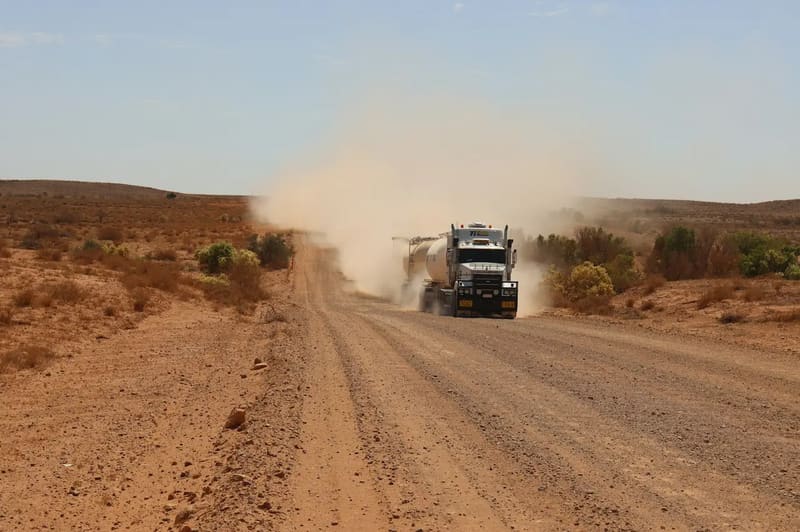
The width limit for a heavy vehicle is 2.5 metres, unless it is a Safer Freight Vehicle or a combination that includes one 3. In October 2023, the Australian Government changed the national road vehicle standards so that new trucks fitted with specific safety features may be up to 2.55 metres wide 3.
There are limits to that change. The NHVR says the increased width applies only to rigid or cab chassis trucks and to prime movers 3. Trailers and buses stay at the old limit 3. Safer Freight Vehicles have general access to the road network, and the NHVR is developing a way for operators to certify older trucks retrofitted with the same safety features 3. Certain devices fitted to a heavy vehicle are left out when its width is measured 3.
Height limits for heavy vehicles
The height limit for a heavy vehicle is 4.3 metres 4. A few vehicle types are allowed to be taller 4:
- vehicles built to carry cattle, horses, pigs or sheep: 4.6 metres 4
- vehicles with at least two decks for carrying vehicles: 4.6 metres 4
- specified semitrailers: 4.6 metres 4
- double-decker buses: 4.4 metres 4
A truck that is legal on the open highway can still be too tall for a particular bridge or tunnel, so drivers of tall loads plan their routes around low clearances.
Length limits by type of truck
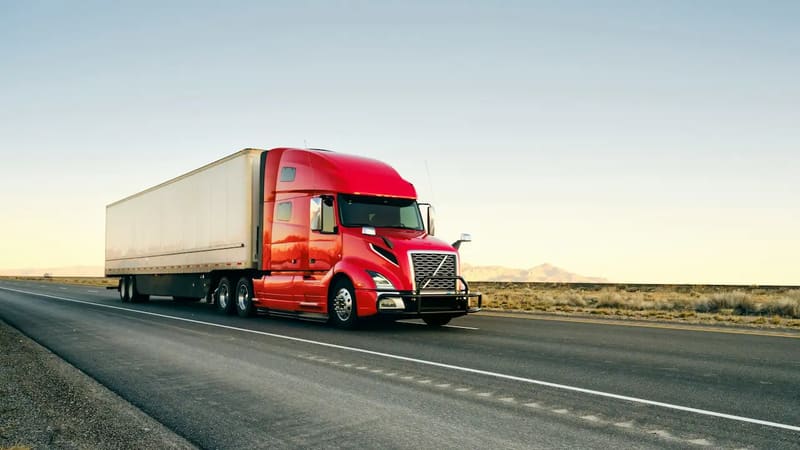
Length depends on the type of vehicle 5:
- a rigid truck, under the general limit for other vehicles: 12.5 metres 5
- a bus other than an articulated bus: 14.5 metres 5
- an articulated bus: 18 metres 5
- a combination such as a prime mover and semitrailer: 19 metres if it includes a heavy trailer without later braking standards that is not powered by the towing vehicle, otherwise 20 metres 5
- a B-double: 25 metres, or up to 26 metres when specific conditions are met 5
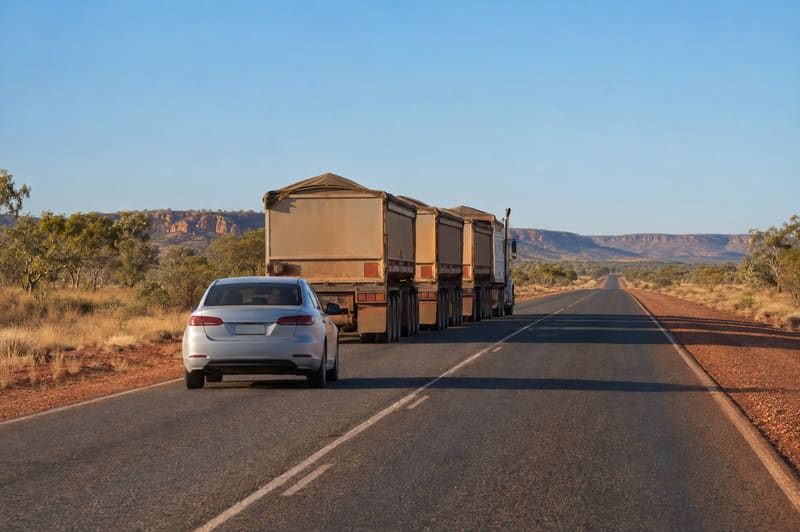
- a road train: 53.5 metres 5
The conditions for a 26 metre B-double include front under-run protection and, for prime movers built after 31 December 2005, a cab that complies with a UN safety regulation 5. Trailers have their own rules inside these totals. For a dog trailer, the distance from the coupling pivot point to the centre of the front axle group must not exceed 5 metres 5. If you want to know how a B-double differs from a road train or a single semitrailer, our guide to the different types of semi-trailers explains each layout.
Some vehicles are allowed to go beyond these numbers. The NHVR says Performance Based Standards vehicles may exceed the prescribed dimensions, as listed in their vehicle approval 2.
How far a load may overhang
A load, or the body of the vehicle, may only project so far beyond the truck. The NHVR sets these limits 6:
- rear overhang on rigid trucks: the lesser of 3.7 metres or 60% of the wheelbase 6
- rear overhang on semitrailers, dog and tag trailers: the lesser of 3.7 metres or 60% of a set trailer dimension 6
- front projection: no more than 1.2 metres in front of the motor vehicle's headlights 6
- side projection: no more than 150 mm past the outer edge of the motor vehicle on either side 6
Loads that go beyond the standard dimensions are oversize, and the NHVR handles applications for oversize and overmass access 8. Conditions can cover the route and the travel times, as well as any pilot or escort vehicles. They vary with the load, so operators check what applies to each trip.
Mass limits and how loads are shared
Size is only half the picture; weight is regulated too. The NHVR describes General Mass Limits (GML) as the basic mass limits that apply to all heavy vehicles 7. The national rules have recently changed here: GML have increased to align with the former Concessional Mass Limits, and the NHVR notes that the concessional category no longer exists under the regulation 8.
Higher Mass Limits (HML) let an operator run above GML, provided the operator is accredited under the National Heavy Vehicle Accreditation Scheme 7.
Responsibility does not stop with the driver
Breaking a mass or dimension limit is not only the driver's problem. Under the HVNL, the Chain of Responsibility makes parties other than drivers responsible for the safety of heavy vehicles on the road 9. The chain runs from the business that employs a driver or owns a vehicle to the business that sends or receives the goods 9. Each party has a primary duty to ensure, so far as is reasonably practicable, the safety of its transport activities 9.

Sharing the road with trucks
For most people reading this, the practical question is how to drive safely near these vehicles. The Queensland Government's guide to sharing the road with heavy vehicles has clear advice 10.
- Stay visible. If you cannot see the truck driver's mirror, the truck driver cannot see you 10. Keep out of the areas directly in front of and directly behind a truck.
- Overtake with care. Road trains can be up to 53.5 metres long, about ten car lengths, and their trailers can sway from side to side, especially the last one 10. Never overtake a heavy vehicle on a curve or hill, where you cannot see far enough ahead 10.
- Give turning trucks room. Heavy vehicles with a DO NOT OVERTAKE TURNING VEHICLE sign are allowed to use more than one lane to turn 10.
- Use overtaking lanes. On single-lane roads, only pass when the road ahead is clear, and use an overtaking lane where there is one 10.
- Leave a gap. Do not follow too closely, so you can see what is ahead, such as debris on the road, and leave more than the usual stopping distance when the weather reduces visibility 10.
A long vehicle also needs time and space to stop and to turn. Give it room at intersections and roundabouts, and do not cut in front of a heavy vehicle after you pass it. The safest place to be is where the driver can see you clearly in the mirrors.
This matters even more if you tow. A car and caravan behind a road train is a long, slow overtake, so plan it carefully or wait for an overtaking lane. Our guide to the best cars for towing a caravan covers how to choose a capable tow vehicle.
Licences, light trucks and the car market
A car licence does not cover the largest vehicles described above. Heavy vehicle licences come in classes that step up from light rigid trucks to the multi-combination class needed for B-doubles and road trains. Each state and territory issues these licences and sets its own tests and experience requirements. If you are thinking about a career behind the wheel of a truck, start with your state transport agency's licensing pages, because the steps differ from state to state.
Light trucks and utes blur the line with cars. The national heavy vehicle rules apply to vehicles over 4.5 tonnes gross vehicle mass 1. Before you buy a large van or light truck, check its gross vehicle mass, because that number decides which rules and which licence apply.
For the history of one maker's light commercial vehicles, read about Mazda trucks in Australia. When you are ready to look at vehicles, browse the cars on Car Domain, and read our buyer safety guide before you inspect a vehicle or pay a deposit.
Sources
- National Heavy Vehicle Regulator, Heavy Vehicle National Law and Regulations, accessed 2 November 2026
- National Heavy Vehicle Regulator, Dimension requirements, accessed 2 November 2026
- National Heavy Vehicle Regulator, Width, accessed 2 November 2026
- National Heavy Vehicle Regulator, Height, accessed 2 November 2026
- National Heavy Vehicle Regulator, Length, accessed 2 November 2026
- National Heavy Vehicle Regulator, Size and projection of loads, accessed 2 November 2026
- National Heavy Vehicle Regulator, Mass limits, accessed 2 November 2026
- National Heavy Vehicle Regulator, Mass and dimension, accessed 2 November 2026
- National Heavy Vehicle Regulator, Chain of Responsibility (CoR), accessed 2 November 2026
- Queensland Government, Sharing the road with heavy vehicles, accessed 2 November 2026


