
Audi is now a familiar sight on Australian roads, but the four rings took a long and winding route to get here. The brand began as one man's second car company, merged into a group of four, disappeared from sale for more than twenty years and then returned under new owners. This history of Audi in Australia starts with those German roots, follows the importers who brought the cars here, and ends with the company that sells them today, along with a debut on the Formula One grid at Albert Park.
How Audi got its name
Audi's story starts with August Horch. After leaving the first company that bore his name, he founded a new firm in Zwickau on 16 July 1909 1. He could not use his own surname for it, so the new company took a translation. "Horch" means "listen" in German, and the Latin equivalent is audi 1. The Audi company was entered in the commercial register on 25 April 1910 1.
The four rings of Auto Union
The badge that every Audi wears today comes from the Depression years. In 1932, Audi merged with Horch, DKW and Wanderer to form Auto Union AG, based in Chemnitz 1. Each of the four rings in the logo represents one of those four car companies 1.
The group was dominated by its smaller, cheaper cars. By 1938, the DKW brand held 17.9% of the German car market, while Audi held just 0.1% 1. After 1939, the Audi name disappeared completely from the new car market for more than two decades 1.

A new start under Volkswagen
Auto Union was rebuilt after the Second World War in West Germany, and its ownership changed hands as the industry consolidated. In 1958, Daimler-Benz took an 87% holding in Auto Union 1. In 1964, Volkswagen acquired a 50% holding, and later gained full control of the business in Ingolstadt 1.
The Audi name came back in 1965, after a gap of 25 years 1. Auto Union then merged with NSU Motorenwerke in 1969 1. The merged company was incorporated on 1 January 1969 as Audi NSU Auto Union AG 1. NSU brought engineering ambition with it: its Ro 80 of 1967 was a car well ahead of its time in aerodynamics and safety, and NSU had focused on rotary engines based on the ideas of Felix Wankel 1. By 1985, with the Auto Union and NSU brands effectively gone, the company's name was shortened to Audi AG 1. Before that came the car that set up the modern company: the Audi 100, launched in 1968, which went on to be a huge success 1. The first-generation Audi 80 followed in 1972 1. Audi is still headquartered in Ingolstadt in Bavaria 1. Its slogan, Vorsprung durch Technik, translates as progress through technology 1.
One more technical step matters to owners of older cars, especially near the coast. Audi produces fully galvanised car bodies, and Wikipedia credits it as the first mass-market maker to do so, after Porsche introduced the process around 1975 1. Galvanising coats the steel with zinc to protect it against rust. When you inspect an older Audi, it is still worth checking for corrosion around the wheel arches and under the boot floor, as you would on any used car.
Quattro changes everything
If one car turned Audi into a brand that enthusiasts noticed, it was the Quattro. The turbocharged, all-wheel-drive Audi Quattro was introduced in 1980 and was a great success in rallying 1. It brought Audi the World Rally Championship manufacturers' title in 1982 and 1984, and the drivers' titles in 1983 and 1984 1. All-wheel drive under the quattro name has been part of Audi's identity ever since.
Aluminium and the A8
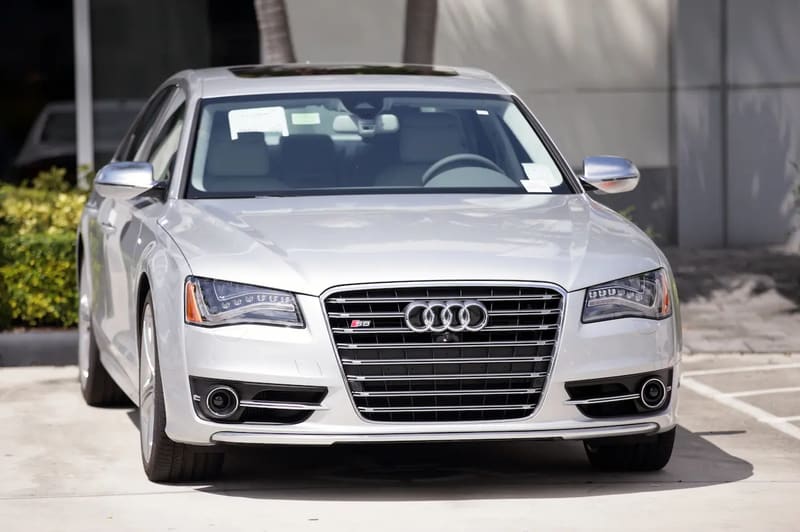
Audi's next big step was in materials. In 1994, the Audi A8 was launched with aluminium space frame technology 1. The silver S8 shown below is a later high-performance version of the same flagship sedan.
The history of Audi in Australia: the importer years
For most of its time in Australia, Audi did not have a factory-owned company of its own. Its cars were brought in by independent importers, and by the late 1990s the importer was Astre Automotive, which also handled Hyundai 4.
The turning point came at the start of the new century. In August 2000, GoAuto reported that negotiations were under way between Audi AG and Astre over the future of the Audi franchise in Australia, with a joint venture expected to be announced 4. In February 2001, Astre said it was confident that 50-50 joint-venture talks with Audi AG would succeed, subject to approval by Audi's supervisory board in Germany 5.
Astre was also selling more cars. It reached Audi's 2000 target of 3,000 cars in Australia, selling 3,016 according to the industry's VFACTS figures 5. The product plans for 2001 show the brand of the time. An all-new A4 was due in November, with its debut at the Sydney Motor Show, in sedan form with a 2.0 litre four-cylinder or a 3.0 litre V6 5. Audi's local marketing manager called the A4 the brand's bread and butter 5.

The more unusual car was the A2, a small hatch that GoAuto described as the first mass-produced aluminium vehicle 5. It was expected in Australia around December 2001, offered only as a 1.4 litre manual, and Audi did not expect it to sell in the same numbers as the A3 5. The A2 showed how Audi wanted to be seen: as the maker that pushed technology into everyday cars.
Audi Australia today
Today the brand is represented here by Audi Australia, which the German-Australian Chamber of Industry and Commerce lists at Zetland in Sydney 6. The model range has grown well beyond the sedans of the 1990s, and Audi's line-up now includes fully electric e-tron models such as the Q4 e-tron and Q6 e-tron 1.
Worldwide, Audi delivered 1,623,551 cars in 2025, down 2.9% on the 1,671,218 it delivered in 2024 7. Fully electric deliveries reached a record of over 223,000 7. The largest single region was China, with 617,514 deliveries 7.
Audi on the racetrack, at home and abroad
Motorsport has been central to Audi's image. Beyond its rally titles, Audi became one of the dominant names at the Le Mans 24 Hours. The R10 TDI, unveiled in December 2005, won the race in 2006 1. The R18 won again in 2011 1, and Audi's run of success in Le Mans prototypes eventually reached its 100th win 1.
Audi's local racing record is strong too. In the Australian Super Touring Championship, which ran from 1993 to 2002, Audi and BMW alternated championship success from 1995 to 1998 2. Brad Jones won the drivers' title in an Audi A4 quattro in 1996 and again in 1998, and Audi Sport Australia took the manufacturers' title in both years 2.
The four rings have also done well at Mount Panorama. The Audi R8 LMS GT3 won the Bathurst 12 Hour outright in 2011, 2012 and 2018 3. Those wins put an Audi on the top step of one of Australia's best known endurance races three times.
Australian fans have one more reason to remember 2026. Audi's Formula One team made its debut at the 2026 Australian Grand Prix in Melbourne 1. For a brand whose first Australian cars arrived through small independent importers, starting a new Formula One chapter at Albert Park was a fitting moment.
Buying a used Audi in Australia
Decades of Audi sales mean there is a wide choice of used cars, from small hatchbacks to large sedans and SUVs. A well kept older Audi can be a rewarding car to own, but repairs on a neglected one can cost far more than the purchase price suggests. Before you buy one, a few checks are worth the time:
- Ask for the full service history, with receipts. Premium cars depend on regular servicing with the right parts and fluids.
- Check what kind of all-wheel drive or transmission the car has, and ask when the transmission was last serviced, if the maker's schedule includes it.
- Have an independent mechanic who knows European cars inspect it before you pay.
- Check the car for finance owing and for a written-off record before you hand over any money.
Reliability varies between brands and models, and our guide to the most and least reliable car brands is a useful starting point. If you are comparing German brands, read about the history of BMW in Australia and Mercedes-Benz in Australia, and see our history of Volkswagen in Australia for the group that owns Audi.
When you are ready to look, browse the cars on Car Domain, work out the repayments with our car loan calculator, and read our buyer safety guide before you inspect a car or pay a deposit.
Where to learn more about Audi
There is plenty of reading for anyone who wants to go further. Audi's corporate site publishes its annual delivery figures 7, and GoAuto's archive includes its 2001 report on Audi's Australian plans 5. Together they show how far the brand has come in Australia since the days of small independent importers. Wikipedia's article on the Australian Super Touring Championship lists the season results from Audi's local racing years 2.
Sources
- Wikipedia, Audi, accessed 2 November 2026
- Wikipedia, Australian Super Touring Championship, accessed 2 November 2026
- Wikipedia, Bathurst 12 Hour, accessed 2 November 2026
- GoAuto, Volkswagen positions materialise, accessed 2 November 2026
- GoAuto, Audi's aluminium attack, accessed 2 November 2026
- German-Australian Chamber of Industry and Commerce, Audi Australia, accessed 2 November 2026
- AUDI AG, Audi delivers 1.6 million vehicles in 2025 as strong fourth quarter ends challenging year, accessed 2 November 2026


