
Mercedes-Benz is now one of the best-known luxury brands on Australian roads, but its start here was modest. For a few years its cars were assembled in Port Melbourne alongside other makes, before the German parent took over and turned to importing finished cars.
This refreshed post replaces an earlier version that repeated several dates and names we could not confirm. It now covers the parts of the Mercedes-Benz Australia story that current sources support, and the classic models that built the brand's name.
Assembled in Port Melbourne
Mercedes-Benz arrived as a local assembly project. In 1958 Australian Motor Industries, a company based in Port Melbourne, negotiated with Daimler-Benz to assemble and distribute Mercedes-Benz vehicles in Australia 1. A new subsidiary was formed to hold the franchise 1.
The cars sold well for a new brand. Passenger vehicle sales records show 729 locally assembled Mercedes-Benz cars sold between July 1959 and June 1960 1. By 1960 Mercedes-Benz had increased its passenger car sales in Australia tenfold on an annual basis 1.
The same factory built other makes as well. Australian Motor Industries assembled the first Toyota built outside Japan, the Tiara, in April 1963 1. Our history of Australian car manufacturing explains how plants like this one fitted into the wider industry.
The German parent takes over
The local partnership did not last long. During the credit squeeze of 1961, Australian Motor Industries restructured and sold its share in the Mercedes-Benz franchise to the German parent company 1. The assembly rights followed. By 1965 the loss of Mercedes-Benz assembly had left the Port Melbourne plant with spare capacity 1.
From then on, Mercedes-Benz in Australia was an importer of cars built overseas. That model has continued ever since, although the way the cars are sold changed sharply in 2022 2.
How Mercedes-Benz Australia sells cars now
In January 2022 Mercedes-Benz moved to fixed-price sales in Australia 2. Under what is known as the agency model, the company set the sale prices, took control of the sales process and kept ownership of the cars, while dealers were paid a fixed commission on each sale 2.
It helps to know what the agency model replaced. Under the traditional franchise system, dealers buy cars from the manufacturer at wholesale prices and resell them at prices they negotiate with customers, setting their own margins 2. Under agency, the manufacturer keeps ownership of the car and sets the price, and the dealer earns a fixed commission 2. A buyer can even purchase online, with the dealership's only role being the handover of the car 2.
Mercedes-Benz was not the first brand to try fixed prices here. Tesla sells directly to customers at set prices, and Honda switched to fixed prices at its dealerships in 2021 2.
Not all dealers welcomed the change. Thirty-eight of the 49 Australian dealerships joined together to seek compensation 2. The dealers argued that they had been pressured into the new agreements and that the change took away the customer goodwill they had built up 2. In August 2023 Federal Court judge Jonathan Beach rejected their claim, which was for $650 million, and dismissed all of the dealers' claims 2.
For buyers, the change means the price is the price. The researchers who wrote about the case noted that some experts warn that removing price competition between dealers could push prices up 2. They also noted that while many buyers will welcome fixed prices, the evidence on how widely they are adopted and liked is mixed, and that it was too early to say whether the agency model is good or bad overall for car buyers 2. If you are buying a new Mercedes-Benz, you can still compare models and equipment carefully, even if haggling is off the table.

The G-Class and the Australian Army
One Mercedes-Benz model has a strong Australian connection through defence. The G-Class began in 1972 with a cooperative agreement between Daimler-Benz and the Austrian company Steyr-Daimler-Puch, and production started in Graz in 1979 4. It was developed as a military vehicle following a suggestion from the Shah of Iran, and it went on sale to civilians in September 1979 4. A 1990 redesign, the W463, moved it from a spartan working vehicle to a luxury model 4. It has been built ever since, which makes it one of the longest-produced vehicles in the company's history 4.
The Australian Defence Force became a major customer. Under the Army's LAND 121 Phase 3A project, the contract provided for the purchase of 2,146 G-Wagons 3. They replaced the Army's Land Rovers, with the last of the variants due in 2014 3.
The link even shaped a civilian car. The G 63 AMG 6x6 was derived from a model developed specifically for the Australian Army in 2007 4. The six-wheeled road version was built from 2013 to 2015 to mark 30 years of G-Class production, and Mercedes-Benz sold slightly more than 100 of them 4.
Classic models that built the name
Two older models explain much of the brand's reputation and are worth knowing if you follow classic cars.
The gullwing sports car
The 300 SL began as a racing car 6. Daimler-Benz developed the W194 endurance racer in 1951, and the road car was introduced at the New York International Auto Show in February 1954 6. It was one of the first cars with mechanical direct fuel injection, which raised output from the racer's 175 hp to 240 hp 6.
Its rarity is part of its appeal. Only 3,258 were built: 1,400 coupes with upward-opening gullwing doors, made from 1954 to 1957, and 1,858 roadsters made from 1957 to 1963 6. Even the meaning of its name is debated. Mercedes-Benz did not explain the letters at launch, and sources still argue whether SL stands for Super Leicht or Sport Leicht, both meaning light 6.
The flagship limousine
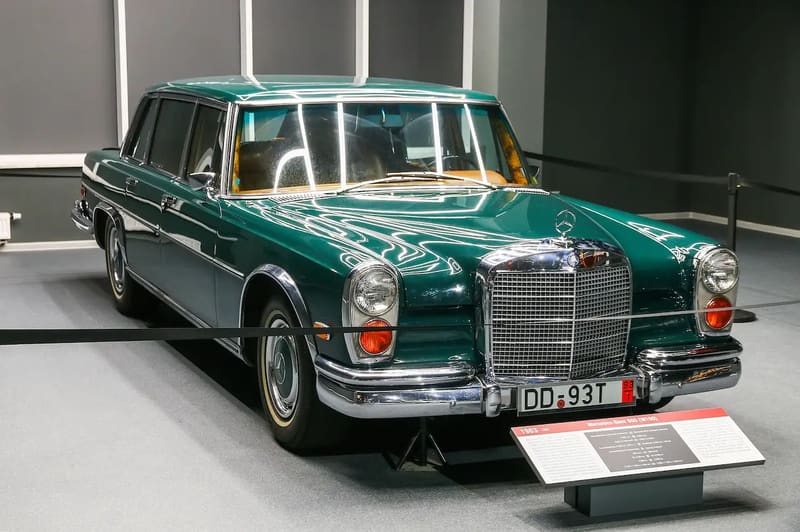
The 600 was built to be the best car the company could make 5. At its launch in 1963 it was the most expensive car in the world 5. Series production began in August 1963 and continued until 1981 5.
It needed a new engine to move its weight. Mercedes-Benz developed the 6.3 litre M100 V8, which produced 184 kW 5. Production totalled 2,677 cars, made up of 2,190 saloons, 304 Pullmans, 124 six-door Pullmans and 59 Landaulets 5. The long Pullman versions had a powered divider window between the driver and the rear seats 5.
Buying a Mercedes-Benz in Australia
Whether you want a new car or an older one, the brand's history affects how you buy.
For a new car, the agency model sets the price nationally 2. That makes it easier to compare one dealership with another, because the difference between them is service rather than price. Ask what is included in the purchase, such as servicing plans or accessories, and get it in writing.
For a used car, the usual checks matter more than the badge. Luxury cars can be expensive to repair, so ask for the full service history and find out when major services fall due. For a model with a lot of electronic equipment, it is worth having a specialist check that everything works before you pay.
For a classic, provenance is everything. Cars such as the 300 SL and the 600 were built in small numbers 6 5, so each one is a rare car, and its value rests on its history and originality. Have one inspected by a marque specialist, and check the paperwork carefully.
When you are ready, browse cars for sale on Car Domain and read our buying safety tips before you pay a deposit. If you are thinking about finance, our loan calculator can help you work out repayments. For more on European cars, see our guide to Maserati and Ferrari parts. The article in The Conversation explains the agency model case in more detail, and the Wikipedia entry for the 600 covers that car's history.
Sources
- Wikipedia, Australian Motor Industries, accessed 2 November 2026
- The Conversation, Mercedes-Benz's legal win over car dealers could transform the way new cars are sold in Australia, accessed 2 November 2026
- Australian Defence Magazine, Land Warfare: Have G-Wagons, will travel, accessed 2 November 2026
- Wikipedia, Mercedes-Benz G-Class, accessed 2 November 2026
- Wikipedia, Mercedes-Benz 600, accessed 2 November 2026
- Wikipedia, Mercedes-Benz 300 SL, accessed 2 November 2026


