
In June 2023 Alef Aeronautics, a California start-up, announced that the US Federal Aviation Administration had given its electric flying car a Special Airworthiness Certification 1. The company called it the first time a vehicle of its kind had received legal approval to fly from the US government 1.
When this post first ran, that certificate was the whole story. More than three years on there is more to report: a public test flight, a start to hand-built production and a clearer picture of the rules the car has to fit. This refreshed version covers all three, and what is still unknown.
What the FAA certificate allowed
The certificate was not a licence to sell flying cars to the public. In its own announcement Alef said the certification limits the places and the purposes for which it can fly 1. The same release noted that the FAA was still working out its policies for electric vertical take-off and landing aircraft, and how they would use the ground infrastructure around them 1.
In other words, the 2023 approval let Alef fly its design for limited purposes under the regulator's eye. It said nothing about when a buyer could drive one home. Alef's chief executive, Jim Dukhovny, welcomed it anyway, telling the press that "this is a one small step for planes, one giant step for cars" 1.
If you are reading this in Australia, keep that distinction in mind whenever a headline says a flying car has been "approved". A certificate to fly a test vehicle in one country is a long way from a vehicle that can be registered for the road and flown by its owner somewhere else.
Who Alef is
Alef Aeronautics was founded on 6 April 2015 and is based in San Mateo, California 2. Its four founders paid for the early work themselves, and a venture fund made a seed investment in 2017, followed by further rounds in 2018 and 2020 2. The company unveiled its Model A in October 2022, showing a full-size sports car model and two working full-size technology demonstrators 1.
According to the company's December 2025 timeline, the idea was sketched on a napkin in a Palo Alto café in 2015, the first subscale prototype was built in 2016 and the first full-size prototype flew in 2019 4.
How the electric flying car is meant to work
Alef describes the Model A as fully electric and able to be driven on public roads. It is also meant to take off and land vertically with one or two occupants on board 1. The design hides its propellers inside the body rather than leaving them exposed, and a gimbaled cabin is meant to keep the people inside steady while the body tilts in flight 3.
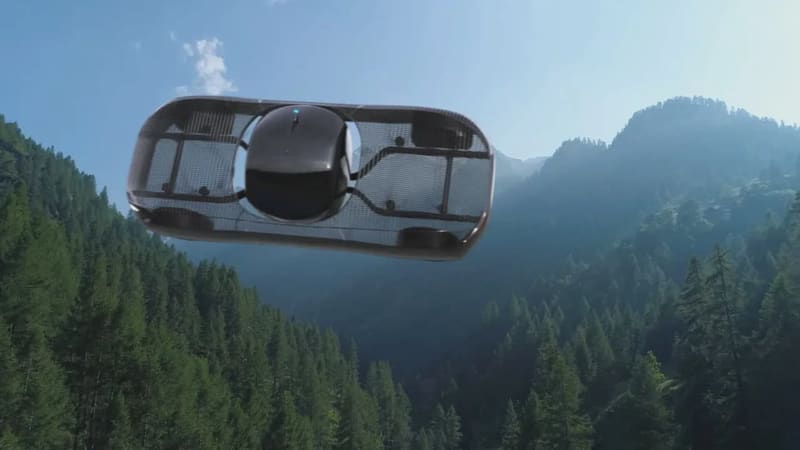
On the road, the plan is modest. Alef intends to have the car certified as a low speed vehicle, which caps it at 25 mph, or about 40 km/h 2. If a driver wants to travel faster, the idea is to fly instead. The planned range is about 180 km in the air and about 320 km on the ground 2.
The company lists several safety features for the design 3:
- triple to octuple redundancy in key components;
- obstacle detection and avoidance;
- the ability to glide to a landing;
- a ballistic parachute.
None of those claims has been tested by Car Domain, and none of them has yet been proven in owners' hands. They are what the maker says the car is designed to do.
The first public test flight
For a long time the obvious question about Alef was whether the car really flew. In February 2025 the company answered it with a video. Designboom reported that on 19 February 2025 an ultralight version of the Alef Model Zero, the company's research and development test model, drove a short way along a road near San Mateo 3. It then lifted off vertically and flew over another vehicle 3. The road was closed and nobody stood under the flight path, with safety crews on standby 3.
Alef billed it as the first publicly released video of a car driving and then taking off vertically, and its chief executive called it the first documented, verifiable flight of a flying car 3. Those are the company's words, not an independent finding, but the footage did show the test vehicle doing what Alef had promised for years.
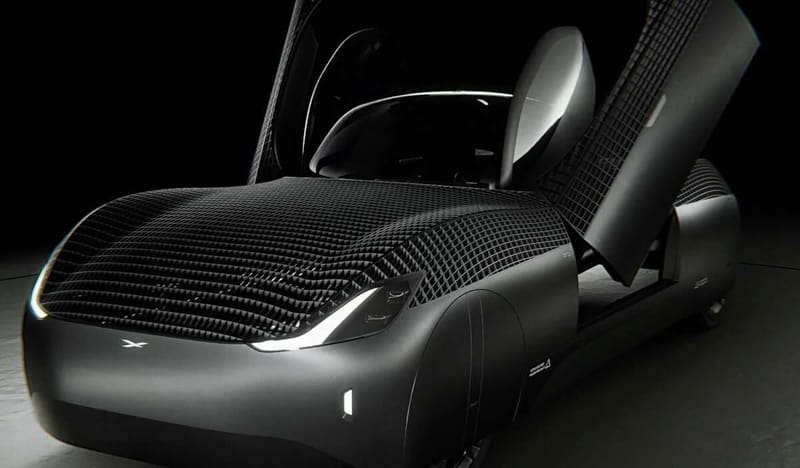
In October 2026 Alef released another video, this time showing its car flying over several vehicles, among them a Tesla Roadster and a Tesla Cybertruck 2.
Production starts, slowly
In December 2025 Alef said production of the Model A Ultralight had started on schedule 4. It is not a factory line. The cars are assembled by hand at the company's facility in San Mateo, and Alef said each early car would take several months of hand craftsmanship 4.

The first cars are not going to the general public either. Alef said only a few customers, no more than ten, would receive early vehicles for real-world, controlled use, with priority going to the earliest orders and the largest deposits 4. Alef also said those early owners would be given operating instruction, with the company providing training, compliance support and maintenance 4. It named customers in California and Hong Kong for those early deliveries, and said timing would depend on how fast the cars could be built and funded, as well as on the safety results from the first ones 4.
At that time the company said it held about 3,500 preorders 4. KTVU reported that Alef's website gave an expected price of about US$300,000, and that the company expects the price to fall sharply if it reaches automated mass production 4. Treat both figures as the maker's own, as at December 2025. Neither is a confirmed retail price, and no Australian price or delivery date was given in any source checked for this post.
The rules an ultralight has to follow
The Model A Ultralight sits under a part of US aviation law written for very light, very simple aircraft. KTVU reported Alef's view that, because the car is classed as an ultralight, a driver's licence is all a US owner needs and no pilot licence is required, with flying limited to daylight and away from congested areas 4.
The regulation itself, 14 CFR Part 103, sets tight limits on what counts as an ultralight. A powered ultralight must 5:
- be used for manned operation in the air by a single occupant;
- be used for recreation or sport purposes only;
- weigh less than 254 pounds, about 115 kg, empty;
- carry no more than 5 US gallons of fuel;
- be capable of no more than 55 knots, about 102 km/h, at full power in level flight.
Another section is blunt: "No person may operate an ultralight vehicle over any congested area of a city, town, or settlement, or over any open air assembly of persons" 6. Put those rules next to the sales pitch and the tension is plain. A single-seat recreational machine that must stay away from towns is not yet the commuter's escape from traffic that the original announcement described. Whether later Alef models can be certified under heavier, more demanding categories is a question the sources do not answer.
Other flying cars, and why runways matter
Alef is not the only company trying to put wings, or rotors, on a road vehicle. In Slovakia, the Klein Vision AirCar first flew in October 2020 and, in June 2021, flew for 35 minutes between the airports at Nitra and Bratislava 7. Slovakia type certified it as an aircraft in January 2022, but it still needed approval as a road vehicle before it could be driven on public roads 7.
The AirCar takes a different approach. It changes from car to aircraft in about two minutes and fifteen seconds, then takes off at around 120 km/h after a run of about 300 metres 7. It runs a 1.6-litre BMW road-car engine on ordinary petrol 7. That makes it closer to a small plane that can be driven than to the vertical take-off car Alef is promising.
Both projects show the same pattern. Getting into the air is the easy headline. Getting a single vehicle approved by both aviation and road regulators, then built in numbers, is the slow part.
What it means for Australian drivers
For now, nothing you can buy. No source checked for this post gives an Australian launch date or an Australian price for the Alef, and its early cars are going to a handful of customers in the United States and Hong Kong 4.
If electric cars that stay on the ground are more your speed, start with our guides to how long an electric car takes to charge and what happens to old electric car batteries. Our look at whether electric cars are better for the environment weighs up the bigger question. For something quick that already holds road registration, browse cars for sale on Car Domain, and our buying safety tips are worth reading before you pay a deposit on anything, flying or not.
You can follow Alef's progress on its Wikipedia entry, and read the US ultralight rules in full.
Sources
- Aviation Pros (Alef Aeronautics press release), Alef Becomes the First Car Certified to Fly, accessed 2 November 2026
- Wikipedia, Alef Aeronautics, accessed 2 November 2026
- designboom, Alef Aeronautics' drivable flying car takes flight for the first time, accessed 2 November 2026
- KTVU FOX 2, Delivery of world's first flying car approaching, with production underway in Bay Area, Alef says, accessed 2 November 2026
- Legal Information Institute, Cornell Law School, 14 CFR 103.1 Applicability, accessed 2 November 2026
- Legal Information Institute, Cornell Law School, 14 CFR 103.15 Operations over congested areas, accessed 2 November 2026
- Wikipedia, Klein Vision AirCar, accessed 2 November 2026


