
For two decades the heart of every Bugatti was a quad-turbocharged W16. In June 2024 the company showed what comes next: the Tourbillon, a hybrid hypercar built around a brand new, naturally aspirated V16 1. That Bugatti V16 engine is the biggest change to the brand's mechanical recipe since the Veyron. When this post first ran the engine was still a set of rumours. It is now a published specification, and the first cars are due with owners this year.
This refreshed guide explains what the new engine is, how it works with the car's electric motors, how it differs from the W16 it replaces, and where it sits among the handful of V16 road cars ever built.
The Tourbillon at a glance
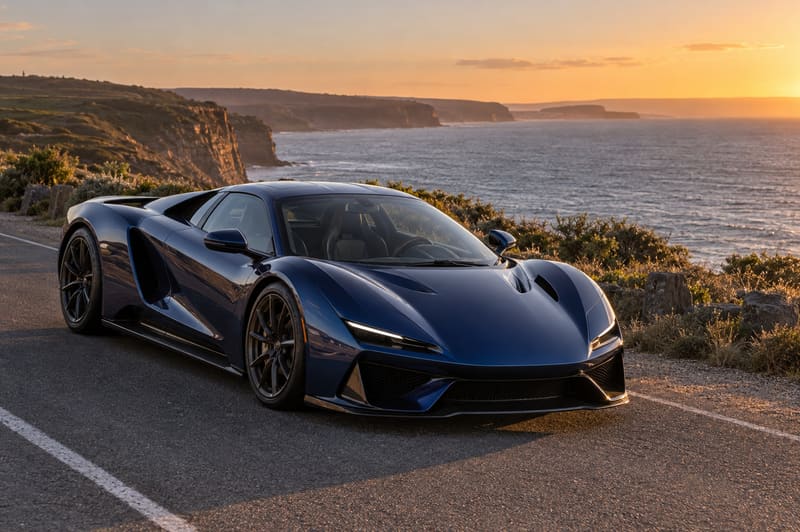
Bugatti unveiled the Tourbillon in an online live stream on 20 June 2024 1. The name comes from the tourbillon, a mechanism used in high-end mechanical watches to improve accuracy 1, and the watch theme runs through the car.
Production is limited to 250 cars, and the starting price was given as €3.8 million 2. The cars are built by hand at Molsheim in France, after production of the Bolide and Mistral is complete, and deliveries were scheduled to begin in 2026 2.
The core numbers, as published at the launch, are:
- an 8.3 litre naturally aspirated V16 developed with Cosworth 2;
- three electric motors, two on the front axle and one at the rear 2;
- a combined output of 1,800 PS, about 1,324 kW 2;
- a new eight-speed dual-clutch gearbox 2;
- a weight of 1,995 kg (DIN), 1 kg lighter than the Chiron 2.
Why the Bugatti V16 engine has no turbos
The headline change is the loss of forced induction. The Veyron and Chiron both used an 8.0 litre quad-turbocharged W16 4 3. The Tourbillon's engine has no turbochargers at all 2.
Turbos made sense when the petrol engine had to do all the work. In the Tourbillon the electric motors fill the gaps that turbos used to cover, so the petrol engine can be tuned for response and sound instead. The V16 revs to 9,000 rpm 2, and Goodwood described that redline as "a visceral, awe-inspiring experience that will echo for eternity" 2.
It is still a big unit. The V16 alone weighs 252 kg 2, and it makes 1,000 PS, about 735 kW, on its own 2. Wikipedia lists its torque at 900 Nm 1.
A V16, not a W16
The difference between the two layouts is more than a letter. A W16 is, in Wikipedia's description of the Veyron engine, "equivalent to two narrow-angle V8 engines bolted together" 4. That packs sixteen cylinders into a short, wide block, which suited a car that also had to find room for four turbochargers.
A V16 puts its cylinders in two long banks. It is a simpler shape, and without turbos and their plumbing there is less to fit around it. There are also fewer hot parts to cool: the Veyron and Chiron had to manage four turbochargers 4 3, while the Tourbillon manages none on its petrol engine and leaves the extra push to its motors 2. The trade-off is length. Bugatti's choice suggests the company decided character mattered more than compactness for this car.
How the hybrid system works
The electric side of the Tourbillon is as important as the V16. Two motors drive the front axle and one drives the rear 2, which gives the car all-wheel drive and lets the front wheels pull without a mechanical link to the engine.
Together the three motors add 800 PS, about 588 kW, and 1,400 Nm 1. The electric powertrain can spin up to 24,000 rpm 2. The front dual-motor e-axle fits into the same space as the Chiron's front axle hardware 2.
The battery
Power for the motors comes from a battery of about 25 kWh running at 800 volts 2. It is built into the car's carbon monocoque rather than bolted on 2. On the WLTP test the Tourbillon can travel up to about 60 km, or 37 miles, on electricity alone 1.
Bugatti also gave the car a new eight-speed dual-clutch gearbox, which Goodwood says was designed to keep the naturally aspirated engine's analogue feel 2. So the electric hardware is meant to add pace without hiding the engine.
The range figure is worth a moment. A car with a sixteen-cylinder petrol engine can, in principle, cover a short city run without starting it. For a hypercar owner the electric range is more about quiet arrivals than daily commuting, but it shows how far the hybrid hardware goes.
Performance claims
Bugatti's published figures put the Tourbillon among the quickest cars ever offered for sale:
- 0 to 100 km/h in under 2.0 seconds 1;
- 0 to 200 km/h in under 5.0 seconds 1;
- 0 to 300 km/h in under 10.0 seconds 1;
- 0 to 400 km/h in under 25.0 seconds 1.
Top speed is electronically limited to 380 km/h, rising to 445 km/h with a speed key 1. These are the maker's claims as published at the launch. They had not been independently tested in any source checked for this post, and Car Domain has not driven the car.
Chassis, cabin and the watchmaker's touch
The engine is only part of the redesign. The monocoque is made of T800 carbon composite 1, and the suspension uses forged aluminium multi-link parts, some of them 3D printed 1. Bugatti says that suspension is 45% lighter than the Chiron's 1. The brakes are carbon ceramic with a brake-by-wire system 2.
The cabin leans hard on the watch theme. The instrument cluster was designed and built by Swiss watchmakers and uses more than 600 parts, in materials including titanium, sapphire and ruby 2. It sits in a fixed central hub while the steering wheel rim turns around it 2.
A touchscreen exists, but it stays hidden until it is needed and supports Apple CarPlay 2. The seats are fixed to the floor, and the pedal box moves electrically to fit the driver instead 2.
From the Veyron and Chiron to the Tourbillon
To see why the Tourbillon matters, it helps to look at the cars it follows.
The Veyron was built from 2005 to 2015, and 450 were made across its coupe and roadster versions 4. Its standard version made 1,001 PS from the quad-turbo W16 4. In July 2010 a Veyron Super Sport averaged 431.072 km/h over two runs at Ehra-Lessien 4.
The Chiron followed from 2016 to 2024 3. It was limited to 500 cars, and the 500th, the Chiron L'Ultime, ended production in May 2024 3. A pre-production Chiron Super Sport 300+ prototype reached 490.484 km/h in August 2019 3.
The Chiron's W16 made 1,500 PS in its standard form and 1,600 PS in the Super Sport and Super Sport 300+ 3. The later Veyron Super Sport and Grand Sport Vitesse had already reached 1,200 PS 4. In the Veyron line, 252 of the 450 cars were the original 16.4 coupe, and the open Grand Sport versions made up most of the rest 4.
Each car raised the W16's output. The Tourbillon takes another route: less boost and more electricity, with a combustion engine chosen for feel. If you enjoy reading about top speeds, our guide to the fastest cars in the world covers the record holders, and our list of the most expensive cars shows where Bugatti's prices sit against its rivals.
The other V16 road cars
V16 engines are rare in road cars. The best-known modern example before the Tourbillon came from a small Italian company in the early 1990s.
The Cizeta-Moroder V16T was built between 1991 and 2003, and only 11 were made, including one prototype and one Spyder 5. Its 6.0 litre V16 was mounted across the car behind the cabin and was based on Lamborghini Urraco V8 parts, with one aluminium block and four cylinder heads 5. It made 540 hp, about 400 kW, at 8,000 rpm 5. The body was designed by Marcello Gandini 5.
The Cizeta shows how hard a sixteen-cylinder road car is to make work as a business. The Tourbillon arrives with a far larger company behind it: Bugatti now sits within Bugatti Rimac, a joint venture of the Rimac Group and HOF Capital 1.
What it means for Australian car buyers
For almost everyone the Tourbillon is a car to read about, not to buy. Even so, it is a useful marker of where performance cars are heading: electric motors are now part of the top tier, and the petrol engine is there for character as much as speed. No source checked for this post gave an Australian price or an Australian delivery date, so treat the €3.8 million figure as a European starting price from 2024 2.
What does reach ordinary drivers is the idea behind it. Pairing a petrol engine with electric motors, and letting the motors do the heavy lifting at low speed, is how most hybrids already work. If that interests you, our guide to the most reliable hybrid cars in Australia is a better place to start shopping than Molsheim. When you are ready to look at real listings, browse the cars for sale on Car Domain, and read our safe buying tips before you hand over a deposit.
You can read more about the car on its Wikipedia page and in Goodwood's launch report.
Sources
- Wikipedia, Bugatti Tourbillon, accessed 2 November 2026
- Goodwood Road & Racing, Bugatti Tourbillon ushers in a fresh era with a new V16 engine, accessed 2 November 2026
- Wikipedia, Bugatti Chiron, accessed 2 November 2026
- Wikipedia, Bugatti Veyron, accessed 2 November 2026
- Wikipedia, Cizeta-Moroder V16T, accessed 2 November 2026


