
For about three decades the name Chrysler meant something particular to Australian drivers. It was the badge on a big six-cylinder sedan built in Adelaide, the car that sat alongside the Holden and the Falcon as the third choice in a market of locally made family cars. That car was the Valiant, and its story is most of the history of Chrysler Australia.
This refreshed history replaces an earlier version of the post that mixed up dates and models. Each date and figure below has been checked against the sources listed at the end of the page, and the model names follow the factory series codes.
How the history of Chrysler Australia began
Chrysler did not arrive in Australia as a factory. It began as a group of sellers. In 1935, 18 independent distributors joined to form Chrysler Dodge Distributors (Holdings) Pty Ltd, a company linked to the Adelaide body builder T. J. Richards and Sons 1. Bodies built locally on imported running gear were the normal way to make a car in Australia at the time.
The American parent took control after the war. Chrysler Australia Ltd was established in June 1951, when Chrysler Corporation acquired the distributor company 1. Production was then pulled together in South Australia. Assembly for Victoria and New South Wales, along with Tasmania, moved to Adelaide in 1953, and assembly in Perth and Brisbane ended in 1954 1.
Through the 1950s the company built large American-style cars under several badges. The De Soto Diplomat was built as a sedan and a coupe utility between 1954 and 1957, and the Chrysler Royal of 1957 brought the badge-engineered models together until its production ended in 1963 1. The Dodge Phoenix followed from 1960 to 1973 1.
Chrysler also tried smaller European cars. After Chrysler Corporation took an interest in the French maker Simca in 1958, assembly of the Simca Aronde and Vedette in Australia was announced on 1 July 1959 1.
The Valiant arrives
The car that changed everything was a compact American design. Chrysler Australia began assembling the Valiant in 1962 1. The first local version, the RV1 or R series, was assembled at the Mile End plant in Adelaide and used the 225 cubic inch Slant Six engine rated at 145 bhp 2.
The S series followed in March 1962, and 10,009 SV1 Valiants were sold, of which 5,496 were automatics and 4,513 were manuals 2. For a newcomer competing with the established Holden and the new Falcon, that was a strong start.
The step that made the Valiant an Australian car came next. The AP5 Valiant was launched on 30 May 1963 as the first fully Australian-manufactured Valiant 2. Production at the new Tonsley Park plant south of Adelaide began on 31 March 1964, and the AP5 run reached 49,440 cars 2.

Tonsley Park and the growth years
Tonsley Park gave Chrysler the capacity to build in volume, and the second half of the 1960s was its strongest period. The AP6 of March 1965 introduced a V8, the 273 cubic inch LA engine with 180 bhp 2. In 1966 Chrysler Australia also took over Rootes Australia and its Port Melbourne factory, which brought the Hillman Hunter into the family 1.
The model changes came quickly. The VC of March 1966 sold in larger numbers, with 65,634 built 2. The VE of October 1967 did better again, at 68,688 cars, and it was named Wheels magazine's Car of the Year for 1967 2. An engine plant at Lonsdale, also in South Australia, opened in November 1967 1.
The VF of March 1969 brought two names that would matter to enthusiasts: the sporty Valiant Pacer and a two-door Hardtop 2. A total of 52,944 VF Valiants were built 2.
The Hemi six and the Charger
In 1970 Chrysler Australia launched its own six-cylinder engine, the 245 cubic inch Hemi six 1. It arrived in the VG Valiant of August 1970, of which 46,374 were built 2. Larger versions followed, including a 265 cubic inch Hemi six of 4.3 litres 2.
The VH series of June 1971 was a new and larger design 2. It also added the car many people still associate with the brand 2. The Valiant Charger was a short-wheelbase coupe on a 105 inch wheelbase, priced from A$2,750 for the base model 1. It won the Wheels Car of the Year award for 1971 3.
The most famous version was the R/T E49. It used the 265 Hemi tuned to 302 bhp, or 225 kW, through a four-speed manual gearbox 3. Cars like it gave Chrysler a performance image to match its rivals' sporting models, even as the family sedans did the selling. Chrysler built 67,800 VH Valiants in all 2.

The best seller, then the slide
The VJ Valiant of May 1973 became the best-selling Valiant of all, with 90,865 sold 2. That peak did not last. The VK of October 1975 managed 20,555 cars before production ended in June 1976 2.
A significant facelift in 1976 slowed the fall in sales 1. The CL series of November 1976 reached 36,672 cars, a figure that includes the last Chargers ever built 2. Charger production ended on 16 August 1978 3.
Chrysler tried other answers as well. The Centura was launched in 1975, given a mild update in 1977 and gone from the market by the end of 1978 1.
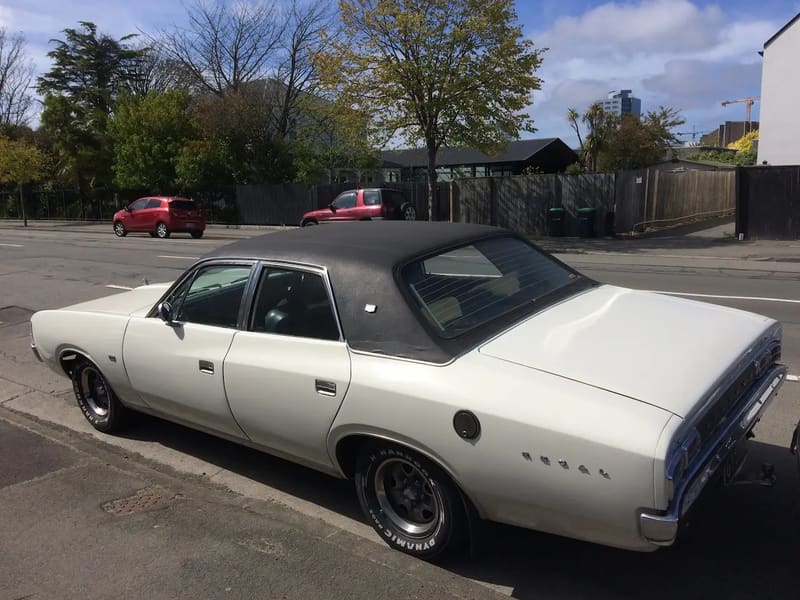
The Mitsubishi connection
The car that kept Tonsley Park busy in the late 1970s came from Japan. In 1971 Chrysler's American parent took a 15 per cent stake in Mitsubishi Motors Corporation, and Chrysler Australia began building Mitsubishi-designed cars 5.
The most important of them was the Sigma. Chrysler launched the GE Sigma in October 1977, assembled at Tonsley Park, to replace the GD Galant 4. It became the leader in its class 1. The GE also brought Mitsubishi's Astron engines to Australia, and a 2.6 litre version arrived in November 1979 4.
Ownership followed the product. In 1979 Mitsubishi Motors Corporation and Mitsubishi Corporation each bought a one-sixth stake in Chrysler Australia 5. On 30 April 1980 they paid a further $52 million for Chrysler's remaining 65 per cent, which gave them 98.9 per cent control 5. The company was renamed Mitsubishi Motors Australia Limited on 1 October 1980 5.
The last Valiant and the end of the Chrysler name
The final series, the CM, arrived in November 1978 and continued under Mitsubishi ownership, with 16,005 built 2. Mitsubishi ended Chrysler badging on the Valiant in August 1981, and Valiant production ended that same month 1 2. The Sigma carried on under the Mitsubishi name until 1987 1.
Tonsley Park outlived the Valiant by almost three decades. Mitsubishi built cars there until 2008, when the plant closed 6. The site is now being developed as the Tonsley Innovation District, which mixes light industry with campuses of TAFE and Flinders University 6. Our history of Mitsubishi Motors in Australia picks up that part of the story.
The Chrysler name later came back as an importer. Chrysler returned to the Australian market in 1994 1. By 2012 Chrysler Australia also distributed Alfa Romeo, Fiat and Fiat Commercial, and the RAM brand followed in 2013 1.
That second chapter ended quietly. The Chrysler marque was withdrawn from the Australian market on 19 November 2021 1. Its last car here was a large sedan from the United States, a long way from the Adelaide-built Valiants that once filled suburban driveways.
Buying a classic Valiant today
Valiants and Chargers are now collector cars, and the series details above matter when you look at one. A VE and a VH may look alike to a passer-by, but they differ in their engines and trim, and in rarity. Build numbers ranged from about 16,000 cars for the CM to more than 90,000 for the VJ 2.
Engines are a good first check. The early cars used the 225 Slant Six, the VG brought the 245 Hemi six, and later cars could have the 265 Hemi or a V8 2 1. A car that claims to be one series but carries the engine of another may have had a sensible swap over its life, or it may be described wrongly, and the price should reflect which.
The badge matters too. Early cars wore the Chrysler name, the Sigma went on as a Mitsubishi, and Valiants built after the takeover kept the Chrysler badge only until August 1981 1. Knowing that sequence helps you spot a description that does not add up.
A few habits help. Match the series to the body and the engine before you trust a seller's description. Ask for paperwork that shows how long the current owner has had the car. For a performance model such as a Charger R/T, expect to verify its history with a marque club or a specialist before you pay a premium.
When you are ready to look at what is listed, start with cars for sale on Car Domain, and read our buying safety tips before you hand over a deposit. For the wider picture of how Chrysler fitted alongside Ford and Holden, read our history of Australian car manufacturing and our history of Ford Australia. The Wikipedia history of the Valiant lists every series with its dates, and the Tonsley entry shows what became of the plant.
Sources
- Wikipedia, Chrysler Australia, accessed 2 November 2026
- Wikipedia, Chrysler Valiant, accessed 2 November 2026
- Wikipedia, Chrysler Valiant Charger, accessed 2 November 2026
- Wikipedia, Chrysler Sigma, accessed 2 November 2026
- Wikipedia, Mitsubishi Motors Australia, accessed 2 November 2026
- Wikipedia, Tonsley, South Australia, accessed 2 November 2026


