
In July 1954, a grey Ford V8 rolled into Moore Park in Sydney with 9,600 miles of Australia behind it. Along the way it had been through Townsville, Mount Isa, Darwin, Broome and Madura, and it had not lost a single point. The driver was Gelignite Jack Murray, a Bondi garage owner who picked up that nickname on this very trip.
His car was a second hand 1948 Ford in a coat of grey paint. His navigator was a man called Bill Murray, no relation, who happened to be an explosives expert. And packed for the trip were boxes of gelignite.
It sounds like the set-up for a pub joke. It became one of the great stories of Australian motoring, and most of it is true.
Who was Gelignite Jack Murray?
John Eric Murray was born in Port Melbourne, Victoria, on 30 August 1907. He left school at 14 to build pushbikes in a bicycle shop, helping the mechanic with cars as well. Then he worked his way around rural Victoria, picking grapes at Mildura and driving a tractor at Sea Lake.
In 1932 he moved to Sydney to test Chrysler cars. By 1933 he and his brother Ray had their own garage and service station in Bondi. The business later moved to Curlewis Street, where everyone simply called it The Garage.
Cars were only half the story. Murray was a champion amateur wrestler who won thirteen NSW State Championships between 1930 and 1946. That same year, 1946, he set the fastest time in the 100 mile New South Wales Grand Prix at Mount Panorama, and then turned down the prize cheque. He had his eyes on wrestling for Australia at the 1948 Olympic Games and did not want to lose his amateur status. So he asked for the £65 to be split between two Police Boys' Clubs.
He was quick on the circuits, too. In 1952 he won the Australian Sprint Championships at Castlereagh airstrip, driving his Cadillac-Allard J2.
Then came the trials.
A trial, not a race
The Redex events were sponsored by REDeX, a British oil additive brand, and organised by the Australian Sporting Car Club of Sydney. They were reliability trials, and the difference mattered.
Nobody won by being fastest. Crews had set times between control points, and the aim was to arrive on time. At fixed controls, turning up more than five minutes early or late cost a point for every minute out. Secret controls allowed three minutes either way per hour, to cover speedometer error and watches that disagreed with the officials'. Murray's biography calls it "a nervous navigator's worst nightmare".
Points also went for the state of the car at the finish. Bonnets and radiator caps were sealed, and breaking a seal cost so many points it was as good as disqualification. The cars had to be ones the public could buy, with few modifications, and replacing parts was strictly limited. The lowest total of penalty points at the end took the win.
On paper it sounds tame. It was not. As the history of the Round Australia Trial explains, the roads through large parts of the country were unformed in the early years, particularly west of Adelaide. Carmakers were keen because it was a severe test of their products, and the newspapers put the trials on their front pages.
The 1953 rollover and a ring spanner
The first round-Australia Redex trial ran in 1953 over 6,500 miles (10,500 km), with a first prize of £1,000. On 30 August, huge crowds at the Sydney Showground watched 192 cars leave at three-minute intervals, and many hundreds of thousands of people turned out along the route over the following week. We have our story on the first round-Australia Redex Trial if you want that one in full.
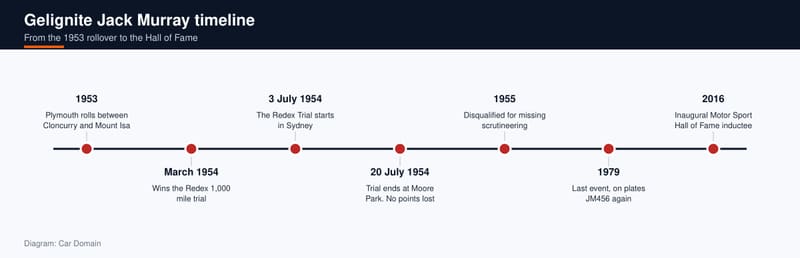
Murray's 1953 run did not end well. He and Bill Murray, no relation, rolled their Chrysler Plymouth between Cloncurry and Mount Isa.
What happened next became Evan Green's favourite story about his larrikin mate. Green opened his 1966 book, Journeys with Gelignite Jack, with it. Another competitor pulled up beside the wrecked Plymouth and asked if they were all right. Murray called back asking for a ring spanner, nine-sixteenths SAE. Asked what on earth for, he explained: "I thought I'd do the brakes while the wheels were up like this." Everyone laughed, the story goes, even poor Bill, bleeding and concussed.
That is the man in a nutshell. Something has gone badly wrong, and his first instinct is a gag.
He was back on form quickly. In March 1954 he won the Redex 1,000 mile trial, a 24-hour event run entirely within New South Wales, losing only 5 points. Many entrants used that event as preparation for the big one in July.
The Grey Ghost was never a taxi
Murray's car for 1954 was a 1948 Ford V8, built in Canada, on number plates JM456. He bought it second hand. It was black, and he repainted it grey.
That grey was the undercoat sort, and it gave the car its name. The famous cricketer 'Ginty' Lush dubbed it the Grey Ghost because of the colour.
Here is where the story gets muddled. Newspapers and magazines often described the big Ford as an ex-taxi. The tag stuck so well that some reference pages on the 1954 trial still use it. Jack Murray's Wikipedia biography says plainly that this is not the case. It was a used Ford that Murray bought and repainted.
We actually prefer the true version. An ex-taxi is a neat hook. But a second hand Ford that a Bondi garage owner bought, painted and pointed at the outback is a better story, because it is exactly the kind of car the Redex rules were written for: something the public could buy, run with few modifications.
For the wider Ford story at home, see the history of Ford Australia, or browse our Ford cars for sale if you fancy a bit of that spirit in your driveway. Undercoat grey is optional.
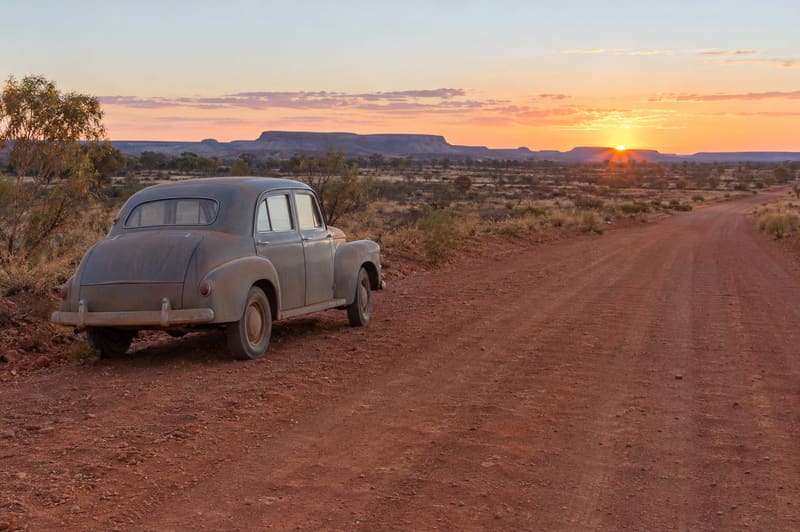
9,600 miles round mainland Australia
The 1954 event, officially the Redex Trial, was the second running of the round-Australia trial. It ran from 3 to 20 July over 9,600 miles (15,400 km), and the first prize was £2,000.
As the encyclopaedia entry on the 1954 trial puts it, the route was truly "round (mainland) Australia". Cars left Sydney for Brisbane, Rockhampton, Mackay and Townsville, then Mount Isa and Darwin. From there the field went on to Broome, Meekatharra and Madura, then Adelaide and Melbourne, before finishing back at Moore Park in Sydney.
A total of 246 cars took part. Only 127 finished within the times allowed, though many stubborn crews kept going and completed the course in the following week. One of those forced to drop out was the celebrated radio personality Jack Davey.
The organisers had a new trick that year. A common criticism of the first trial was the number of competitors who drove at dangerously high speeds to recover time lost in a stage. For 1954, "secret" intermediate checkpoints were brought in to curb the speeding.
Against that field, Jack and Bill Murray lost no points at all. Not one, over the entire route.
Think about that under the rules. Every control met within minutes, every seal intact and the car still in good order at the finish, on roads that in large parts were unformed. It is a remarkable result.
Bill Murray, the navigator with the gelignite
Bill Murray was a lot more than a passenger with a map. Murray's biography describes him as navigator and co-driver, and also as a construction and explosives expert.
That last skill explains the cargo. The two Murrays took boxes of gelignite on the trial, intending to clear any fallen trees or other obstacles blocking the narrow outback roads. As plans go, it has a certain practical logic. It was also never needed. The gelignite was never used for its intended purpose.
Here is our mildly unpopular opinion: the explosives are the least impressive part of 1954.
Everyone remembers the bangs. Fewer people dwell on the fact that a reliability trial was won or lost on timing, and the timing sat largely with the navigator. Under rules that cost a point for every minute out at the fixed controls, a clean sheet over 9,600 miles says as much about the man reading the route as the man turning the wheel. In our view, Bill deserves equal billing with the nickname.
Even in the famous rollover story he is "the poor 'No Relation' Bill". We reckon that is a bit rough on the man who helped bring a big grey Ford all the way round the country without a single penalty.
How Gelignite Jack got his name
So if the gelignite was not clearing the road, what was it doing? Murray's biography has the answer: it became Jack's toy.
He earned the nickname on the 1954 trial, from his occasional celebratory detonation of sticks of gelignite. He was happy to say where it started. "They christened me 'Gelignite Jack' after the big bang in the tin outhouse at Townsville Showground," he is quoted as saying.
He also had a view on safety that would not survive a modern risk assessment. "Gelignite wouldn't hurt a flea out in the open," he said. "It's just the same as a cracker, only louder."
Not everyone was charmed. The record of the 1954 trial describes the bangs as a custom that delighted some and infuriated others. We suspect the people running the controls were more often in the second group, but that is our guess, not history.
Now for the twist. Despite the larrikin image, Murray was a non-smoker and a teetotaller who did not take unnecessary risks. The bangs were showmanship. The driving, judging by a clean sheet across the continent, was disciplined.
It is a good reminder that the loudest person in the room is not always the wildest one. Sometimes he is just the one with the matches.
After 1954, the Grey Ghost kept going
Murray never had another trial quite like it. He called the 1955 Redex Trial a "shemozzle". Near the end, an unplanned diversion through a boggy paddock near Werong Station left some cars stuck for ten hours or more. By his biography's account, Murray protested by not presenting his car for scrutineering in time, and he was disqualified, costing him a possible fourth place. The bog section was later cancelled anyway.
The Grey Ghost was back for the 1956 Ampol Trial, with his brother Ray. A stub axle and king pin broke, and fellow competitor Robert Whan let Murray take parts from his own car, which had crashed into a tree. Later, Murray took a wrong turn after Mount Isa and ended up at the Mary Kathleen uranium fields. He denied being lost. "I've got shares in that company," he said. "I just wanted to see how it was getting on."
Over the years he competed in seven round-Australia trials and raced at Bathurst across a 21-year span. His last competitive event was the 1979 Repco Trial, in a Holden Commodore shared with his elder son John and a mate. It wore number plates JM456, the same as the old Grey Ghost.
Murray died on 11 December 1983. In 2013 he was inducted into the Australian Rally Hall of Fame, and in March 2016 he was an inaugural inductee of the Australian Motor Sport Hall of Fame. Even the 1977 film Newsfront used footage from the 1954 Redex Trial.
Not bad for a second hand Ford in undercoat grey. If a car with that kind of history appeals, have a look through our classic cars for sale. Just leave the gelignite at home.
Sources
- Wikipedia, Jack Murray (racing driver), accessed 12 November 2026
- Wikipedia, 1954 Round Australia Trial, accessed 12 November 2026
- Wikipedia, Round Australia Trial, accessed 12 November 2026


