
The Ford Ranger is the vehicle more Australians bought in 2025 than any other 1. It topped the national sales chart with 56,555 sales, ahead of the Toyota RAV4 with 51,947 and the Toyota HiLux with 51,297 1. If you are shopping for a ute, there is a good chance a Ranger is on your list.
This post replaces our earlier Ranger review, which described the model sold in the United States, with its engines and prices. This version covers the Ranger sold in Australia. It is a buyer's guide built from published specifications and independent reporting, not a road test: Car Domain has not driven or tested the vehicle.
The current Ranger and where it comes from
The current Ranger is the second generation of the T6 design. It debuted in November 2021 and went on sale in Australia on 19 July 2022 2. It was developed by Ford Australia, with input from Ford teams on several other continents 2.
So while no Ranger is built here, the ute has strong local roots. Our history of Ford Australia explains how the company moved from building Falcons to leading development of the Ranger. Rangers are assembled overseas, with Thailand among the main plants, and the plug-in hybrid is built in South Africa 2.

Ford Ranger body styles and grades
The Ranger comes in a wide range of shapes. Australian buyers can choose from 2:
- Single Cab, Super Cab or Double Cab bodies;
- a pick-up with a tub, or a cab-chassis ready for a tray;
- six grades at launch: XL, XLS, XLT, Sport, Wildtrak and Raptor.
The right choice depends on the job. A single-cab chassis suits a tradie who needs a flat tray and little else. A double-cab pick-up suits a family that wants five seats and a covered load space. The higher grades add equipment and styling, but they also add cost and, in some cases, weight that eats into payload. Check the payload figure for the exact version you are considering rather than the brochure's best case.
Engines
The diesel engines are the core of the range. Ford offers three, in rising order of output 2:
- a 2.0 litre single-turbo four-cylinder with 127 kW and 405 Nm 2;
- a 2.0 litre bi-turbo four-cylinder with 150 kW and 500 Nm 2;
- a 3.0 litre V6 turbo-diesel, which RACT lists at 184 kW and 600 Nm 3.
The Raptor is the outlier. It uses a 3.0 litre twin-turbo petrol V6 rated at 292 kW for Australia 2. It is aimed at fast off-road driving, so check its own towing and payload figures against your needs before you pay for it.
The plug-in hybrid
The newest Ranger is a plug-in hybrid. It was unveiled in September 2023 and launched in Australia in March 2025 2. It combines a 2.3 litre EcoBoost petrol engine with a 75 kW electric motor and a 10-speed transmission 4.
Its numbers are strong. RACT reports combined outputs of 207 kW and 697 Nm, more than the V6 diesel, from a battery with 11.8 kWh of usable capacity 3. It quotes a pure electric range of 49 km on the NEDC test and combined fuel use of 2.9 litres per 100 km 3. Ford's own figure is up to 43 km on the WLTP test 4, so expect real-world electric range to vary with load and conditions.
The plug-in Ranger also has a feature called Pro Power Onboard, which can power tools on a worksite, or equipment at a campsite, from sockets in the tray and cabin 3. In September 2025 RACT reported prices from $71,990 for the XLT PHEV to $86,990 for the launch-edition Stormtrak 3. Prices change, so check the current figure with Ford.
Living with a plug-in ute
The plug-in hybrid suits some owners far better than others. It makes most sense if you can charge at home and many of your trips are short enough to run on battery power. If you mostly drive long distances or tow heavy loads, the petrol engine will do most of the work and the battery's benefit shrinks.
Before you buy one, check where you would charge it, whether your switchboard and parking space suit a home charger, and how often you would really plug in.
Towing and payload
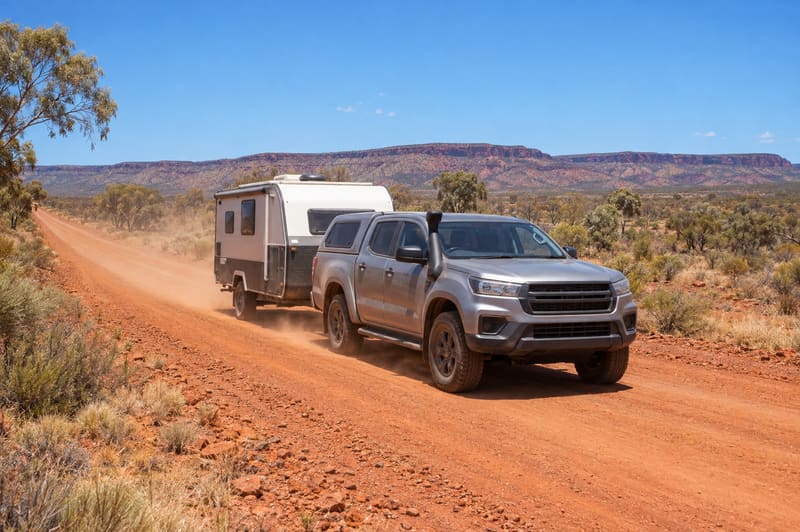
Towing is one of the main reasons Australians buy a Ranger. The plug-in hybrid keeps the same 3,500 kg braked towing capacity as the petrol and diesel versions, with 750 kg unbraked 3.
That headline number is a maximum, not a promise for every load. Ford itself puts it plainly: "Max towing varies based on cargo, vehicle configuration, accessories and number of passengers" 4. Payload works the same way: Ford says maximum payload varies with accessories and configuration 4.
In practice, a ute carrying passengers and a canopy, with gear in the tub, has less capacity left for a trailer. Before you tow a caravan or a boat, add up the weight of everything in and on the vehicle as well as the trailer, and compare it with the figures on the vehicle's placard and in its handbook. If you are weighing up towing cars more broadly, our guide to buying a car safely and our answers to common questions are useful starting points.
Understanding mass limits
Two terms on a ute's placard matter as much as the towing figure. Gross vehicle mass is the most the vehicle itself may weigh when loaded, including passengers, fuel, accessories and cargo. Gross combination mass is the most the vehicle and its trailer may weigh together.
The two limits interact. A ute that is close to its gross vehicle mass may not be able to tow its maximum trailer without exceeding its gross combination mass. That is why two Rangers with the same towing rating can be legal with very different loads. Read both figures on the placard and in the handbook for the exact vehicle, and if you tow often, consider having your loaded combination weighed at a public weighbridge.
Running costs and safety
Fuel use depends heavily on the engine you choose and how you use the ute. The plug-in hybrid can run short trips on electricity when it is charged 3, but towing a heavy load will use far more fuel than any test figure suggests. The diesel engines differ in output, so a lighter four-cylinder may suit city work while the V6 suits frequent heavy towing.
For safety, check the Ranger's current rating on the ANCAP website before you buy, and confirm that the specific grade you want has the driver assistance features you expect. Ratings and standard equipment can change between model years.
Buying a used Ranger
The Ranger's popularity means there are many used examples, which is good for choice. A few checks help you find a good one.
First, identify the generation. The current model went on sale here in July 2022 2, so earlier Rangers are a different design with different engines and equipment. The picture in this post shows an earlier-generation double cab.
Second, look closely at how the ute has been used. Utes often work hard, so check:
- the tub or tray for dents and wear from heavy loads;
- the towbar and its wiring for signs of frequent towing;
- the underside for scrapes and damage from off-road driving.
Ask for service records, especially for a vehicle that has towed often.
Third, check modifications. Lift kits and larger tyres are common on Rangers, as are heavy accessories such as bull bars and canopies. They can change how the ute handles and how much it may legally tow or carry. Make sure any changes are legal in your state and properly recorded.
When you are ready, browse cars for sale on Car Domain, and use our loan calculator to estimate repayments. If you are also weighing up hybrids and electric vehicles, read our look at whether electric cars are better for the environment. The RACT's Ranger plug-in hybrid article has more detail on that model, and the FCAI's 2025 sales summary shows how the Ranger ranks.
Sources
- Federal Chamber of Automotive Industries, Australia's new vehicle market remains resilient, accessed 2 November 2026
- Wikipedia, Ford Ranger (T6), accessed 2 November 2026
- RACT, Ranger recharged, accessed 2 November 2026
- Ford Motor Company, Ranger PHEV towing, accessed 2 November 2026


