
Ferrari needed 200 cars to take the Ferrari 288 GTO Group B racing. It built 272. Then the racing went away.
That is the odd, slightly sad and thoroughly brilliant story of a twin turbo V8 coupe built at Maranello from 1984 to 1987. At a glance it looks like a 308 GTB that has spent a winter at the gym. Underneath, very little of the 308 survived. It was meant to be a ticket into a new racing class. Instead, through a handful of stranded race cars and a lot of Saturday overtime, it led to the F40.
A rule book that asked for 200
Group B arrived in 1982. The FIA wrote it for grand touring cars in both rallying and sports car racing. Most people remember the rally side, the wild years that fans still call the golden era of rallying. Ferrari's story sits on the circuit side.
The appeal was the paperwork. To homologate a car, or get it approved for the class, a maker had to build 200 of them. That was half of what the old Group 4 had accepted. A maker could then build just 20 "evolution" cars to bring in upgrades. That loophole produced the famous homologation specials, rare road cars built mainly to satisfy the rule book.
Turbo engines carried a catch. With forced induction, the rules treated an engine as 1.4 times its actual size. The 288 GTO and Porsche's 959 were placed in the 4,000 cc class (2857 cc with a turbo). According to the history of the Group B regulations, that class would probably have become the normal one for circuit racing if Group B had seen much use there.
The name tells you the intent. GTO stands for Gran Turismo Omologata, and that last word is Italian for homologated.
Not quite born to race
The popular version says Ferrari built the GTO purely to go Group B racing. Wikipedia's account of the GTO says it was not immediately born to compete in the new Group B circuit series.
At the time, Enzo Ferrari did not have overall control of his company's road car division. That job sat with general director Eugenio Alzati and Fiat's managing director, Vittorio Ghidella. In 1983, Enzo heard from close friends and clients that road car sales were falling, thanks to stronger rivals and what he called the "excessive gentrification" of the Ferrari range. To his mind, the cars had gone soft.
Turbos offered a way back. Turbocharging was winning in Formula 1, and new tax laws on engines above 1999 cc gave Ferrari another nudge. It built the 208 Turbo first, then began talking about a 3 litre turbo road car with 330 bhp.
Enter Nicola Materazzi, head of powertrain at the Gestione Sportiva, Ferrari's racing division, who had joined from Osella in 1979. He was confident that 400 bhp could be reliably pulled from 3000 cc. Ferrari placed his trust in him, on condition that he delivered, and jokingly suggested he also work on the engine for Lancia's LC2 Group C racer.
How the Ferrari 288 GTO differs from a 308
The plan was to modify a 308, to keep costs down and build the car quickly. By the time the GTO was finished, little of the 308/328 was left. Ferrari could live with the blown budget because loyal customers would pay more for performance and style that nothing else could match.
The 308 carries its V8 across the car. The GTO turns it around and mounts it lengthways, using what had been the 308's rear boot space, to make room for the twin turbochargers and intercoolers. A racing gearbox sits behind the engine, which moved the rear wheels back and stretched the wheelbase.
Then there is the body. Look for bulging wheel arch flares, bigger front and rear spoilers, large flag-style mirrors and four driving lights at the outer edges of the grille. Two details nod to the original 250 GTO: slanted vents in the rear guards to cool the brakes, and the design of the rear wing.
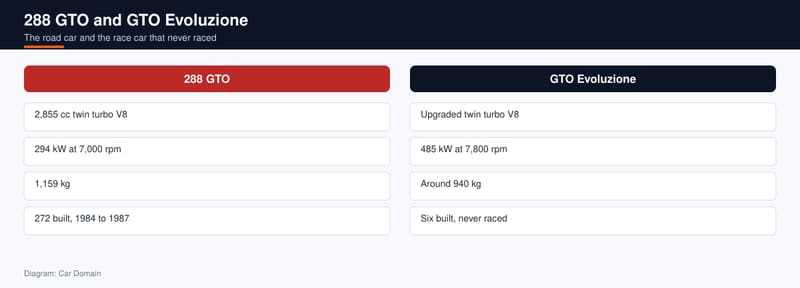
The materials changed too. The doors are steel, but the major body panels are moulded fibreglass. The bonnet is Kevlar, and the roof is Kevlar and carbon fibre. The result weighed 1,159 kg, against 1,399 to 1,520 kg for the 308/328.
The maths behind the name
The 308 GTB's V8 displaced 2,927 cc. For the GTO, Ferrari reduced the bore by 1 mm, bringing it down to 2,855 cc. Why shrink a Ferrari engine? Group B maths. Multiply by the 1.4 turbo factor and you get an equivalent of 3,997 cc, just under the class limit of 4.0 litres. The 288 in the name refers to that 2.8 litre V8.
The turbochargers were water cooled units from IHI in Japan, chosen over the turbochargers used in Formula 1 because better materials and internal aerodynamics gave a faster response. Add Behr air-to-air intercoolers, Weber-Marelli fuel injection and a 7.6:1 compression ratio, and the result was 294 kW at 7,000 rpm.
Ferrari claimed a top speed of 304 km/h, making the GTO one of the fastest road-legal production cars of its time. When Road & Track tested one, it recorded 288 km/h. A 288 that tops out at 288 is the sort of coincidence we cannot help enjoying.
Formula 1 driver Michele Alboreto, who occasionally gave feedback on the car, called it "cattiva", which means angry, and praised its low engine centre of gravity compared with the Testarossa. After all that talk of gentrification, that is quite the compliment.
Ferrari built 272
The FIA asked for 200. Ferrari built 70 more, plus a couple of extras to please the Agnelli family, a Formula 1 driver or anyone else Enzo thought might insist on a last-minute purchase. The total came to 272. Enzo offered GTOs to several Formula 1 drivers, including Michele Alboreto, Keke Rosberg and Niki Lauda, and Lauda was gifted the very last of the 272 by Enzo himself.
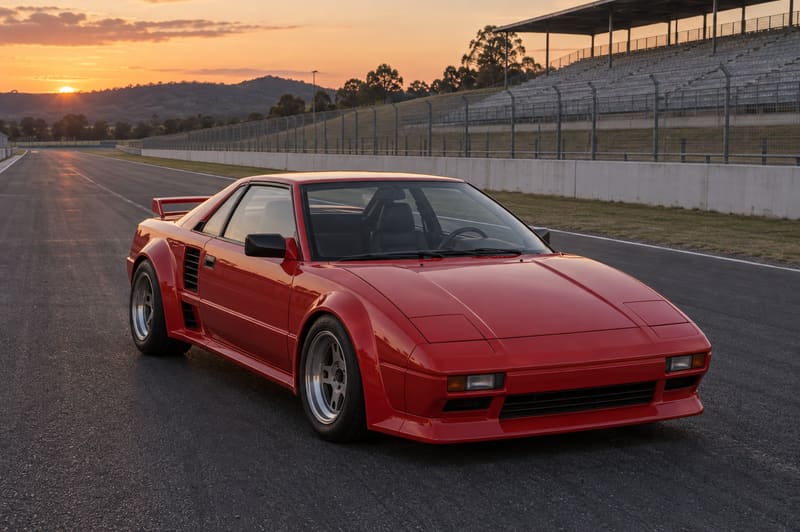
Every GTO road car was left-hand drive and painted Rosso Corsa, the most common Ferrari factory colour. So if you dream of a right-hand drive example for Australian roads, the history notes one conversion. In 1990 a single chassis went to Pininfarina to be converted to right-hand drive and repainted Dark Slate with a red stripe, before it reached the Brunei royal family.
These cars arrived with a story baked in, and it got richer when the F40 turned up at five times the price. If the GTO has you browsing, our Ferrari cars for sale page is the closest most of us will get, and our list of parts shared between Maserati and Ferrari is a fine rabbit hole for engineering fans.
Saturdays at Maranello
Materazzi had a bigger idea. With new road speed limits and stricter fines, he felt it was getting harder for owners to prove what fast cars could really do. His answer was to take Ferrari back to GT racing, something it had not done since the 512 BB LM.
Eugenio Alzati signed off, with one condition. The engineers could only work on it outside the Monday to Friday timetable. So a very small team built the race car on Saturdays, aiming at the same Group B class Porsche had entered with the 959.
The result was the 288 GTO Evoluzione, introduced in 1986. It borrowed lessons from Lancia's LC2 engine work, such as carefully shaped intake plenums that balanced the air flow to each cylinder. Power rose to 485 kW at 7,800 rpm, weight dropped to around 940 kg and the top speed was reportedly 362 km/h. The body gained front canards, a large carbon fibre rear spoiler and numerous large NACA ducts.
Group B rules called for 20 evolution cars, and Ferrari planned a run of 20. It built six: five production models and one prototype. The Padua specialist Michelotto also worked on the Evoluzione.
The race that never came
Then Group B fell apart. On the rally stages, 1986 brought a run of fatal accidents. In May, Henri Toivonen and his co-driver Sergio Cresto died when their Lancia Delta S4 crashed at the Tour de Corse. Immediately afterwards, the FIA banned Group B from the World Rally Championship from the following season.
The circuit series went too. Because of the deaths and the danger in Group B rallying, it was suspended at the end of 1986, and the world sports car grids the GTO had been meant for filled up with Group C cars.
That left the Evoluzione stranded. It was not fit for any other series, so the project was shelved and the Evoluzione never raced. The road car met the homologation rules, yet never saw competition in its own category. The Group B history records one footnote, limited use in an IMSA GTO race in 1989, which is about as close as the GTO came to the career it was built for.
Here is our slightly contrarian take. We reckon losing its race was the best thing that ever happened to the 288 GTO. A racing career might have meant crashes, rebuilds and endless arguments about originality. Instead it stayed a road car with an unanswered question attached, and nothing gets car people talking like a what-if.
From orphan to F40
So Enzo Ferrari was left with five Evoluzione development cars and no series to enter. Then a validation driver convinced Enzo that Materazzi could keep the concept alive and make it roadworthy. Enzo wanted to leave a legacy in his final sports car, and the Evoluzione programme became its base.
The project began on 10 June 1986. Enzo wanted it finished in eleven months. Pietro Camardella drew the body under the supervision of Aldo Brovarone at Pininfarina, while Materazzi made the engine, gearbox and other mechanical parts roadworthy. Michelotto handled some of the development too, such as the bodywork. The F40 was revealed on 21 July 1987 at the Civic Centre in Maranello, thirteen months after the project began.
The family tie is plain. The F40 used an enlarged 2,936 cc version of the 288 GTO's twin turbo V8, rated at 352 kW, and took many styling cues from the Evoluzione. One Evoluzione is suspected to have served as a prototype during F40 development. The F40 was the last Ferrari personally approved by Enzo, and it cost about five times as much as the GTO.
Observers at the time saw the F40 as a cynical attempt to cash in on speculators, after seeing what was being paid for used 288 GTOs and the Porsche 959. So the GTO's second-hand prices became part of its successor's story, as the F40's development history explains.
Second only to the 959
All six Evoluzione cars are thought to still exist. One is owned by the factory and sits on display in the engine manufacturing facility in Maranello. The road cars have earned their place in the record books too. In 2004, Sports Car International named the 288 GTO number two on its list of the top sports cars of the 1980s, behind its German rival, the Porsche 959. Fitting, given the two were placed in the same Group B class.
The F40 gets the bedroom posters, and we understand why. But the 288 GTO did the hard yards. It supplied the twin turbo V8 that the F40 enlarged, and its Saturday race programme, the Evoluzione, fed straight into the F40's design.
If that kind of backstory appeals, there are plenty of classic cars for sale with tales of their own, and our piece on Australia's only McLaren F1 shows how rarity drives desire. Any old exotic also lives or dies on its maintenance, which is why we keep banging on about never skipping a scheduled service.
The 288 GTO never got its race. It got the F40 instead, which seems a fair trade to us.
Sources
- Wikipedia, Ferrari 288 GTO, accessed 11 November 2026
- Wikipedia, Ferrari F40, accessed 11 November 2026
- Wikipedia, Group B, accessed 11 November 2026


