
The Land Cruiser 300 Series is Toyota's flagship four-wheel-drive wagon, and in Australia it carries a name that has been working in the bush for generations. It was unveiled on 9 June 2021 and went on sale here on 5 October 2021 1, replacing the long-running 200 Series.
When this post first ran, the 300 Series was a diesel-only range 1 with prices from its launch years. Much has changed since. Toyota has raised prices and added a petrol-electric hybrid to the top of the range. This refreshed guide sets out the range as it stands and what each powertrain offers. It also covers towing and the checks to make on a used one.

What changed from the 200 Series
The 300 Series is built on a new body-on-frame platform, Toyota's GA-F, with a frame redesigned to be lighter and stiffer 1. Toyota cut about 200 kg from the car compared with its predecessor 1.
The biggest change for many buyers was under the bonnet. The 200 Series' twin-turbo V8 diesel gave way to a 3.3 litre twin-turbo V6 diesel making 227 kW and 700 Nm, driving through a 10-speed automatic 1. It was also the first Land Cruiser wagon offered as a GR Sport, a version with differential locks at both ends 1.
If you are weighing up the older car, our guide to the Land Cruiser 200 Series covers what to look for in a used V8.
The grades and their prices
The range now offers two powertrains across six grades, so start with the grade and then decide on the engine.
In Australia the 300 Series is sold in six grades: GX, GXL, VX, Sahara, GR Sport and Sahara ZX 1. Toyota raised prices by $1,000 across the line-up from 1 January 2026 2. The diesel prices from that date, before on-road costs, were 2:
- GX: $99,340 2;
- GXL: $111,820 2;
- VX: $123,510 2;
- Sahara: $140,310 2;
- GR Sport: $147,160 2;
- Sahara ZX: $147,910 2.
On-road costs vary by state, so the drive-away price will be higher. Prices also change during the year, so treat these as a snapshot from early 2026 2 and check Toyota's own site before you budget. Our car loan calculator can show what the repayments on a car at this price might look like.
Choosing a grade
The grades run from a working wagon to a luxury car. The GX is the entry point for buyers who want the 300 Series' mechanical package without the luxury equipment 2. The two Sahara grades sit at the comfort end 2. The GR Sport stands apart with its locking differentials front and rear 1.

Engines: diesel or hybrid
Toyota now sells the 300 Series with two quite different powertrains 3. Both drive all four wheels all the time and both use a 10-speed automatic 1 3, but their character and running costs differ.
The V6 diesel
The diesel remains the core of the range. Its 3.3 litre twin-turbo V6 makes 227 kW and 700 Nm 3, and RACV lists its claimed combined fuel use at 8.9 L/100 km with a 110 litre fuel tank 3.
Those numbers beat the old V8 on paper 1. The 200 Series' diesel made 200 kW and 650 Nm in its final form 1, so the smaller V6 gives more power and torque from a lighter car.
The new hybrid
In 2026 Toyota added a petrol-electric hybrid to the 300 Series 3. RACV reported in May 2026 that it combines a 3.4 litre twin-turbo V6 petrol engine with a single electric motor between the engine and the 10-speed automatic 3. It keeps permanent four-wheel drive and a low-range transfer case 3.
The outputs, according to RACV 3:
- petrol engine: 305 kW and 650 Nm 3;
- electric motor: 36 kW and 290 Nm 3;
- system combined: 341 kW and 790 Nm 3.
That makes the hybrid the most powerful 300 Series by a wide margin, with 114 kW more than the diesel 3. It is offered in two grades only 3:
- GR Sport hybrid: $156,060 before on-road costs 3;
- Sahara ZX hybrid: $156,810 before on-road costs 3.
That is a premium of $8,900 over the equivalent diesel grades 3. RACV put the drive-away prices for a private buyer in Victoria at $173,827 for the GR Sport and $174,649 for the Sahara ZX 3, which shows how much on-road costs add at this end of the market. RACV said the hybrid was due on sale in mid-2026, with orders open 3, and that Toyota says the diesel "will be around for decades" 3.
Diesel or hybrid: the trade-offs
The hybrid is not simply a better diesel. The two suit different owners, and RACV's figures show where they differ 3:
| Diesel | Hybrid | |
|---|---|---|
| Combined fuel use | 8.9 L/100 km | 10 L/100 km |
| Fuel tank | 110 litres | 98 litres |
| Fuel | Diesel | 95 RON premium unleaded |
| Braked towing | 3,500 kg | 3,500 kg |
The hybrid uses more fuel on the official test and carries less of it 3, which matters on long outback runs between fuel stops. It also needs premium unleaded 3, so check that it is sold along the routes you plan to drive. In return it brings much more power and torque 3.
For remote touring, the diesel's range is hard to beat. For buyers who mostly drive on sealed roads and want the strongest performance, the hybrid has the edge.
Towing and payload
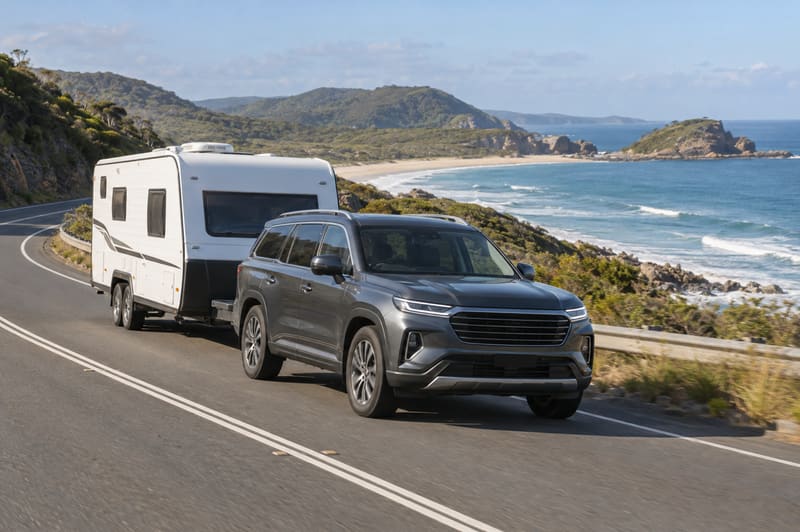
Both powertrains are rated to tow 3,500 kg braked and 750 kg unbraked, with a gross combination mass of 6,750 kg 3.
Payload is close between them. RACV lists 665 kg for the hybrid, against 650 kg for the diesel GR Sport and 670 kg for the diesel Sahara ZX 3. The hybrid's kerb weight is 2,715 kg, and its gross vehicle mass is 3,380 kg, 100 kg higher than the diesel's 3.
When you tow, the tow ball weight counts against payload, and the gross combination mass caps the car and trailer together. A heavy caravan, a full load of passengers and touring gear can reach these limits faster than many owners expect. Our guide to the best cars for towing a caravan explains how to check your numbers.
Safety equipment
ANCAP's page lists the 300 Series' standard airbags 4:
- dual frontal airbags 4;
- side airbags protecting the chest and the head 4;
- knee airbags for the driver and the front passenger 4.
There is no centre airbag between the front seats 4. Autonomous emergency braking is standard on every variant, including the versions that work at junctions and for pedestrians and cyclists 4. So is a lane support system that steers the car back into its lane in an emergency 4. Reverse autonomous emergency braking is the exception: ANCAP lists it as not available on the base variant 4, so check for it if you are shopping for a GX.
For the independent crash test result, see ANCAP's rating page for the 300 Series 4. It covers cars built from July 2021, and it notes that the rating does not apply to the GR Sport 4. Check the page for the rating's date and the variants it covers before you rely on it.
Buying a used 300 Series
The earliest 300 Series cars went on sale in October 2021 1, so the oldest are now about five years old. A few checks are worth making:
- Confirm the grade and powertrain. The GR Sport has its own locking differentials 1, and hybrids exist only in the GR Sport and Sahara ZX 3.
- Ask about towing and off-road use. A car that has towed heavy loads or done hard off-road work needs a closer look underneath and a check of the service records.
- Check accessories. Bull bars, winches, drawers and roof racks add weight that comes off the payload.
- Run the history checks. Consumer Affairs Victoria says a PPSR check for money owing costs $2 5, and a vehicle report can show whether a car is listed as stolen or written off 5.
- Get an inspection by a mechanic who knows these vehicles, and ask whether any recall work is outstanding.
Our safe buying guide covers the scams to avoid, and you can browse cars on Car Domain.
Which Land Cruiser 300 Series to choose
The 300 Series keeps the Land Cruiser formula of a strong separate frame and permanent four-wheel drive, with a 3,500 kg towing rating 3, and wraps it in a lighter, more modern package than the 200 Series 1. The V6 diesel suits remote touring and heavy towing, thanks to its range on a tank 3. A bigger fuel tank and lower claimed fuel use add up to more kilometres between stops, which is what matters most on a long trip through remote country. The hybrid adds a lot more performance at a higher price and a cost in range 3.
In short:
- For remote touring and heavy towing: a diesel, in the grade whose equipment you need 3.
- For the most performance: the hybrid, in GR Sport or Sahara ZX form 3.
- For off-road hardware: the GR Sport, with its front and rear differential locks 1.
- For the lowest price of entry: the GX diesel 2, keeping in mind the safety equipment it does without 4.
Whatever you choose, take a long test drive on the kind of roads you will actually use, and if you tow, try it with a trailer attached.
For more detail on the new hybrid, read RACV's report on its price and specifications.
Sources
- Wikipedia, Toyota Land Cruiser, accessed 2 November 2026
- The Standard (ACM), Popular Toyotas cop price rise: 2026 Toyota LandCruiser 300 Series, Prado and C-HR are now up to $1500 more expensive, accessed 2 November 2026
- RACV, 2026 Toyota LandCruiser hybrid: price, specs and release date, accessed 2 November 2026
- ANCAP, Toyota LandCruiser safety rating, accessed 2 November 2026
- Consumer Affairs Victoria, Vehicle status check, accessed 2 November 2026


