
Subaru is one of the few brands in Australia that is known for one engineering idea. Almost every car it sells here drives all four wheels, and most use a flat boxer engine. That focus has made Subaru Australia a familiar name on country roads and gravel rally stages as well as in suburban driveways.
This refreshed post replaces an earlier version that was written largely in the brand's own marketing voice and mixed in American history. The milestones below are checked against the sources listed at the end of the page, and the claims we could not confirm have been left out.
Where Subaru comes from
Subaru is the car brand of a Japanese engineering company. Fuji Heavy Industries was founded on 15 July 1953, and the parent is now called Subaru Corporation 2. The name Subaru is the Japanese word for the Pleiades star cluster, which explains the stars on the badge 2.
Its first well-known car was tiny. The air-cooled Subaru 360 arrived in 1958 2. The engineering features that define the brand came later. Subaru's Symmetrical All Wheel Drive layout was introduced in 1972, and its cars are known for using a boxer engine in most models above 1,500 cc 2.
A boxer engine lays its cylinders flat, in two opposed banks, rather than standing them upright. Subaru pairs that low, wide engine with a drivetrain laid out evenly along the car, and the combination has been its signature for decades.
Subaru has also worked closely with a much larger Japanese carmaker. Toyota raised its share of Fuji Heavy Industries to 16.5 per cent in July 2008 2.
Subaru Australia arrives
Subaru's Australian story as a national brand starts in 1973, when Subaru Australia was formed as a national importer 1. It has grown a long way since then, and more than one million Subarus have been sold in Australia 1.
The car that made the brand's name here was a small ute. The Subaru Brumby, sold elsewhere as the BRAT, arrived in Australia in 1978 3. It was a two-door coupe utility with four-wheel drive 3, and the 50th anniversary coverage calls it the brand's breakthrough here 1. Australian versions could be ordered with local extras such as a roo bar, a sump guard and a rear step bar 3. Imports continued until February 1994 3.
The Brumby suited rural buyers who wanted a light load tray with the grip of four-wheel drive. It gave Subaru a foothold well beyond the cities, which is where the brand's reputation for practical all-wheel-drive cars began.
Rally success
Subaru built its reputation on gravel. The WRX began as a version of the Impreza created for the World Rally Championship in 1992, and Subaru says the name stands for World Rally eXperimental 5. Subaru took the championship's manufacturers' title three years in a row, from 1995 to 1997 2.
Those wins made the Impreza famous and gave the road-going WRX an image that has lasted for decades. Australian rallying kept the link alive. In 2016 Molly Taylor became the first female driver to win the Australian Rally Championship 9. She later won the first Extreme E championship in 2021 9.

The Liberty and the WRX
One of Subaru's best-known Australian models carried a different name from the rest of the world. The Legacy was introduced in 1989, but in Australia it was sold as the Liberty because the name Legacy conflicted with Legacy Australia, the organisation that supports the families of veterans 4. The Liberty name was used here until 2020 4.
The WRX has had its own changes of identity. For the 2015 model year it was separated from the Impreza range and became a model in its own right 5. In March 2022 Subaru said it would not sell a second-generation WRX STI with a combustion engine 5.
The current WRX uses a 2.4 litre turbocharged boxer engine 5. Australia also gets a wagon version. On 14 October 2021 the second-generation Levorg arrived here as the WRX Sportswagon, with the same 2.4 litre turbo engine as the sedan 5.
The Outback and the Forester
Subaru's family cars grew from the same formula of all-wheel drive and a raised wagon body. The Forester first went on sale in Japan in February 1997, after being shown as the Streega concept at the 1995 Tokyo Motor Show 8. It suited Australian buyers who wanted one car for both the city and gravel roads.


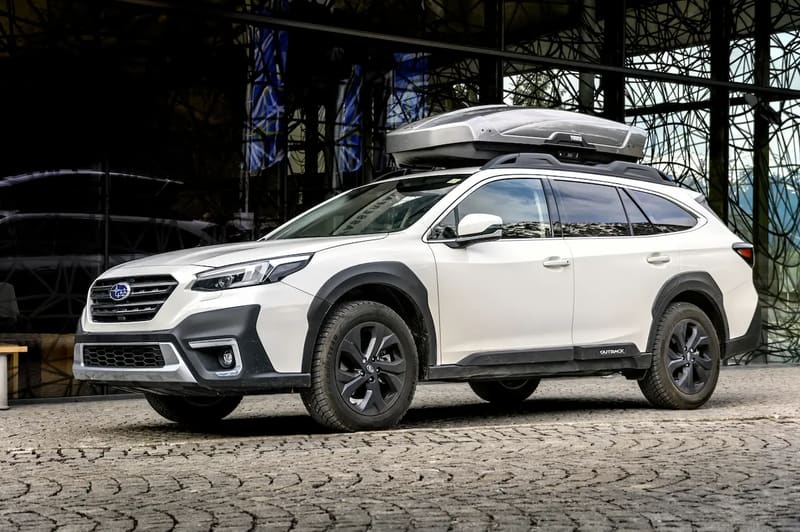
The Outback has an Australian connection in its name. It was introduced at the 1994 New York Auto Show as a wagon derived from the second-generation Legacy, and it was named the Legacy Outback after the Australian outback 6. When it was launched in Australia in 1996, the name was shortened to simply Outback 6. Australian cars have followed the Japanese specification rather than the American one 6. The seventh generation began in 2025 6.
The smallest of Subaru's raised models has also changed its name. Outside North America it was sold as the XV for its first two generations, starting with sales in Japan on 25 September 2012 7. The third generation of 2022 was the first to use the Crosstrek name around the world 7, so a used XV and a new Crosstrek are members of the same family.
The Forester is now in its sixth generation. That model was revealed at the Los Angeles Auto Show on 16 November 2023 8. It was launched in Australia on 28 May 2025 in four variants, Standard, Premium, Sport and Touring, with a 2.5 litre petrol engine or a 2.5 litre petrol hybrid 8. Before you buy, look up its safety rating on the ANCAP website rather than relying on a summary in an advertisement.

Fifty years in Australia
Subaru Australia marked 50 years in 2023 with special editions 1. There were five 50 Years Edition models: the Forester 2.5i, the Forester 2.5i-S, the Outback Touring XT, the WRX and the WRX Sportswagon 1.
Subaru also brought driver assistance into its range over that time. It introduced its EyeSight collision avoidance system in 2008 2. EyeSight uses cameras mounted behind the windscreen to watch the road ahead. If you are comparing used Subarus, check whether the specific car has it, as it was not fitted to every model or year.
Buying a used Subaru
Subarus have a loyal following, and many older ones are still on the road. The brand's history gives you a few things to check before you buy one.
First, know which generation you are looking at. A WRX from the 1990s and a current WRX are very different cars, even though they share a name. The model year tells you which safety features and engine to expect. The same goes for a Liberty, which may be listed under its Legacy name in some overseas records 4.
Second, ask for the service history. All-wheel-drive cars have more driveline parts than two-wheel-drive ones, and any car with high kilometres rewards regular maintenance. A seller who can show records is a better bet than one who cannot.
Third, be careful with modified performance cars. The WRX and STI have long been popular with enthusiasts, and many have been changed from standard. A modified car is not always a bad buy, but check that the work was done properly and that the car is still roadworthy and correctly registered in your state.
Fourth, match the car to how you will use it. A Forester or an Outback suits buyers who tow light loads or drive on gravel, while a WRX is a performance car first. If you plan to tow, check the car's braked towing capacity in its handbook or on its compliance plate before you hitch anything up, and do not rely on a figure quoted for a different model year.
Finally, for a classic such as a Brumby, expect age-related wear. Imports ended in 1994 3, so even the newest examples are now more than 30 years old. Check the body and the underside carefully, and ask how parts have been sourced.
When you are ready, browse cars for sale on Car Domain and read our buying safety tips first. For more Japanese car history, read our look at the Nissan Skyline GT-R from Fast and Furious and our history of Mitsubishi Motors Australia. The Wikipedia entry for Subaru covers the company's global history, and Marque Automotive News reported the 50 years editions.
Sources
- Marque Automotive News, Special edition Subarus celebrate 50 years in Australia, accessed 2 November 2026
- Wikipedia, Subaru, accessed 2 November 2026
- Wikipedia, Subaru BRAT, accessed 2 November 2026
- Wikipedia, Subaru Legacy, accessed 2 November 2026
- Wikipedia, Subaru WRX, accessed 2 November 2026
- Wikipedia, Subaru Outback, accessed 2 November 2026
- Wikipedia, Subaru Crosstrek, accessed 2 November 2026
- Wikipedia, Subaru Forester, accessed 2 November 2026
- Wikipedia, Molly Taylor, accessed 2 November 2026


